Tag: family

  • Boiling Water and Other Premium Adult Skills

    Boiling Water and Other Premium Adult Skills

    My daughter recently declared that I am a “premium adult.” I’m not entirely sure what that means, but I like the sound of it. Apparently, I have skills and knowledge above the beginner level, though I don’t check all the boxes.

    For instance, I don’t have matching towel sets or feel smug about my multiple drawer and cabinet organizers. But I do use cloth napkins, have retirement accounts, keep folders for current and past taxes, and hold strong opinions on the proper way to fold a fitted sheet. Bonus points: I’ve figured out you can make a bed using only flat sheets—it’s easier, and they fit every time. Folding problem solved.

    Premium adults know things newbie adults don’t. My kids were shocked to discover their dishwashers have filters. They were even more shocked (and maybe a little grossed out) to learn those filters need cleaning. They weren’t surprised that I knew this and do it. They haven’t.

    Their questions cover the full spectrum of “How do I adult?”—from choosing a doctor from a vast HMO list to eliminating the lingering cat pee smell left by a roommate. My solutions aren’t always popular. One child had to replace carpet. The other still hasn’t made the doctor’s appointment.

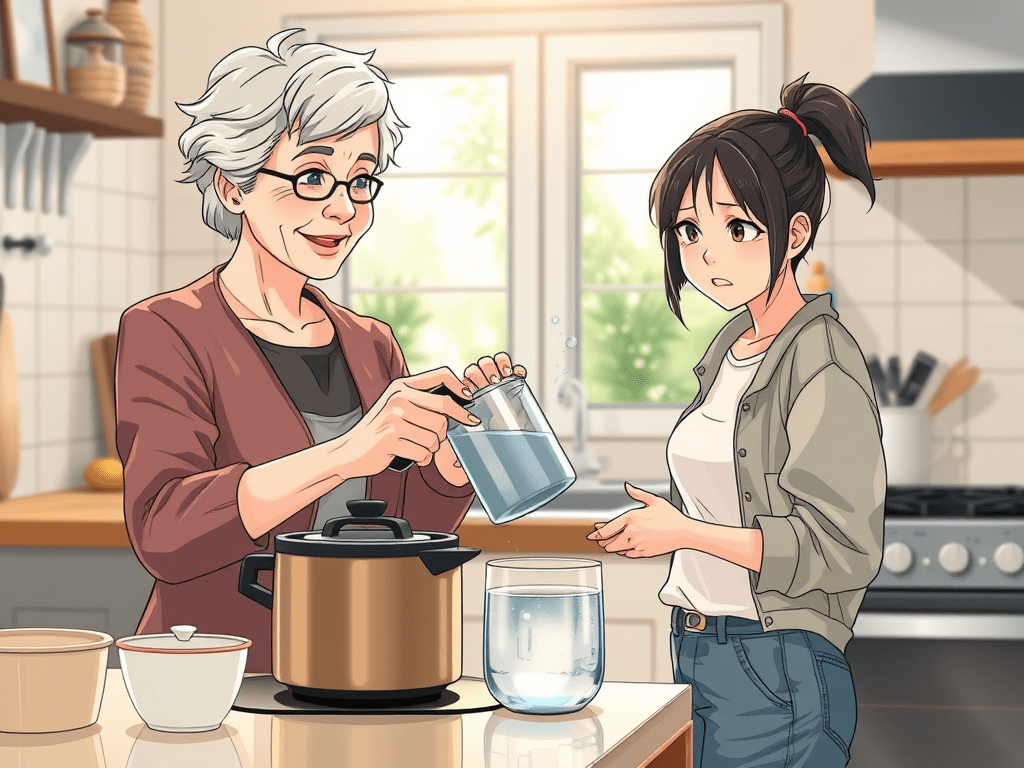
    Some issues are laughable to fellow premium adults. Take boiling water. It sounds foolproof, but it requires surprising amounts of skill, knowledge, and courage. Step one: overcome fear of open flame. Step two: know what size pot to use, how much water to add, how high the flame should be, and what “boiling” actually looks like.

    Sure, you could Google it, but apparently, a lot of people still don’t know. One YouTube tutorial on boiling water has 1.9 million views. Pasta-cooking videos abound, each with its own rules. Mine: add a tablespoon of salt, never oil, and stir to prevent sticking. But why would you when your mother is a premium adult.

    My son calls for cooking help, too—mainly to decipher the sloppy cursive and minimal directions in my family recipe book. My chili recipe lists ingredients but offers only: Brown the meat. Add everything else. Simmer until flavors blend. I’ve also coached him through replacing a water heater, repairing siding, and banishing the infamous cat pee smell.

    I’m not bullet proof, though. Recently, my son had to bow out of a family fun night. We seldom have all four of us in the same location now that the kids have flown the nest. Happily, everyone’s schedule came together so we could celebrate our daughter’s birthday. She requested hot dogs grilled by her brother. He was all on board, then he wasn’t. The night before the celebration, he texted to say he felt sick. By morning, he had fever, aches, congestion—the works.

    While in Meijer with my daughter, I took his call. He listed his symptoms and mentioned his temperature. A few seconds later, my brain caught up, and I texted back my “premium” alarm:

    “That’s a high fever. Take Tylenol or ibuprofen. Call me in 30 minutes. If it’s not down, I’m taking you to the hospital.”

    Thirty minutes later, he replied:

    “Mom, I think you misheard me. It’s 100.4°, not 104°.”

    Side note: My children insist I need hearing aids. I insist they mumble. The ear doctor sided with me—they mumble.

    To my credit, 104° is an emergency. 100.4° barely registers. It’s a “why are you even calling me?” temperature. But I know why he was calling.

    When you’re sick, you miss your mom—premium or not.

  • The Signs of Success

    The Signs of Success

    The street I live on is lined with black and gold signs—the school colors of the nearby high school—displayed proudly in front of homes with graduating seniors.

    Beyond graduation announcements, several signs highlight the next educational step:

    Kids heading to DePaul, Northwestern, University of Illinois, and a handful of other Big Ten universities.

    The most coveted names—Harvard, Yale, University of Chicago—pop up now and then.

    It’s the season of pride—pride in someone else’s accomplishments: our children’s.

    What you don’t see:

    “College of DuPage Bound” signs.

    Attending community college, while financially wise, doesn’t seem sign-worthy.

    Facebook Feeds of Pride

    Facebook is even more saturated with parental pride.

    I don’t use it as much these days. Instead of seeing updates from my friends, I was seeing what their kids were doing—and they were all succeeding in the ways society measures success.

    Of course, parents should be proud of their children.

    But all this pride production comes at a steep cost.

    Success Beyond the Signs

    My kids are amazing—though neither of them went to Brown.

    They’ve achieved things that largely go unnoticed.

    High school wasn’t hard for my son.

    But academic success was—thanks in large part to ADHD.

    He could match the top students on tests, but couldn’t remember to bring home, do, return, or turn in assignments.

    His behavior, not his intelligence, kept him from being recognized.

    He’s a talented musician, too—drums at age three, later guitar and bass.

    But his school had few opportunities for someone whose music fits better in a mosh pit than a music hall.

    Following high school, he found a job where his inability to sit still was an advantage. He worked hard and was able to buy a house in his twenties. Not a condo—a drummer needs a basement, after all.

    My Daughter: Persistence Grapples With Emotional Health

    My daughter’s achievements are equally impressive.

    She was driven from the start. I remember one day in grade school:

    “I failed, Mom,” she said.

    I was surprised—she never failed anything in school. I asked about her grade.

    “I failed,” she repeated.

    “It doesn’t matter! I failed!”

    Then it dawned on me.

    “Honey, did you fail—or did you fail to get the grade you wanted?” She nodded. I asked what grade she had received, expecting a B, maybe a C.

    “I got an A,” she cried.

    “What on earth grade did you want?” I practically shouted.

    “I wanted an A+,” she wailed.“I failed, Mom,” she said, visibly upset.

    But high school hit differently.

    She took honors English and Social Studies. She was on the accelerated math track, and a cheerleader.

    Her days were packed—practice, dinner, then homework until she fell asleep with her head on her book, then woke to finish at 2 a.m.

    By sophomore year, she broke—physically and mentally.

    School attendance became impossible. Then, everything but sleep became impossible.

    Eventually, with an IEP and a transfer to virtual school, she graduated.

    Despite dealing with anxiety disorder, OCD, and major depressive disorder, she persevered.

    She’s been working since 16, is now 22, and already planning her retirement with a financial advisor.

    What Gets Recognition?

    I pass by my kids’ old high school every day on my way to work.

    The sign out front rotates between celebrating the school’s state ranking and its students’ academic and athletic successes.

    At the schools where I teach robotics and STEM, the cultural and economic realities are vastly different—but the emphasis on achievement is just as strong.

    Test scores are posted on bulletin boards—but only the high ones.

    Perfect attendance gets stars. A single sick day makes perfection impossible.

    Rethinking What We Celebrate

    Achievement is deeply personal, yet we’ve made it a universal, quantifiable metric:

    • Get A’s
    • Win awards
    • Come in first
    • Earn scholarships
    • Get into “the best” college

    But what if we celebrated something else?

    I’m not talking about the “everyone is a winner” trophy—students know that’s a crock.

    They know what gets real recognition.

    It’s not that they aren’t achieving amazing things.

    It’s that the amazing things they do aren’t the ones we put on signs.

  • Adoption–and Stupidity–are Forever

    When my daughter was in kindergarten, her teacher developed a semester-long unit of study on Antarctica. Being the helpful soul that I am, I suggested the class sponsor a penguin. They’re cute, they live in Antarctica and they are endangered. The teacher agreed and the class collected money for the sponsorship. They sent the money off to whichever  “Save Antarctica” organization it was that was collecting children’s pennies for penguins.

    Some time later, my daughter asked me, “ Mommy, when will we get the penguin?”

    “What penguin,” I asked, having forgotten the penny collection.

    “The penguin!” she said, vehemently, apparently believing that additional verbal force might force my brain into remembering.

    “I’m sorry, honey,” I said, “I just don’t know what penguin you’re talking about.”

    “The one we adopted, Mommy! When do we get to bring him home?”

    My daughter wasn’t trying to be cute. The penguin-saving organization called their sponsorship an “Adopt a Penguin” program. In our house, when you adopt something, you take it home and then you care for it and love it forever. My daughter was thinking it was about time we flew down to Antarctica and brought that penguin home, just as we’d flown to China to bring her home. I’m relieved that my daughter’s school didn’t adopt a highway. I don’t think it would fit in our living room.

    My daughter has been home for nearly eight years now and one thing I’ve learned in all that time is that people can be pretty darn stupid when it comes to adoption. Actually, people can be pretty darn stupid about a lot of things, but adoption really seems to bring out the insensitive jerk in a whole lot of people.

    We may get more than our share of stupid adoption comments because my daughter is Asian; my husband, my son and I aren’t. If you have eyes that work, it’s pretty evident that our daughter was adopted. My son is particularly annoyed by people who, on seeing him with his sister, ask if she was adopted. “No,” he likes to say, “my parents converted to Chinese after I was born.” I will admit, with shame, that I have used a similarly smart-assed response to one too many questions about how I came to be the parent of an Asian girl.

    Actually, asking if my daughter is adopted is annoying to me because no one ever asks me if my son is born. That sounds ridiculous, doesn’t it? My son was born, of course, but I’m really glad he isn’t born over and over again. Adoption, however, is something that many apparently believe happens repeatedly, as if my daughter wakes up every morning and we have to become a family all over again. She was adopted. It happened once, just like being born. Let’s move on, people.

    I’m pretty sure people who adopted children from the United States that look like their parents don’t get some of the super stupid questions that we who adopted internationally do. I was once asked if we planned on teaching our daughter English. English, for crying out loud! Chinese, I could understand. I don’t speak Chinese. My husband doesn’t speak Chinese. Our son speaks some Chinese, but didn’t then. I wanted to say, “Of course, we’re going to teach her English. Are you going to stop being an idiot?”

    When my son was born, a switch in my brain was flipped and I became vigilant about protecting him. With my daughter, the protection factor went into overdrive. Perhaps it’s understandable, given the moronic comments adoptees must endure. Because society forces it on families built through adoption, we see potential adoption-related issues in every situation. Recently, a friend’s daughter confessed that she was very worried about being labeled different at her school. She was in tears over her anxiety. My friend assumed, of course, that her daughter’s adoption was at the root of the problem. Nope. Her daughter didn’t want the other children to know she doesn’t like pie.

    The real stupidity about adoption comes out over reality. I like to think of myself as real. I’m pretty honest and down to earth. Plenty of people have complimented me on how real I am. But when it comes to parenting my daughter, I become an imaginary being. Apparently, some people believe my daughter was adopted by fairies because I keep getting asked where her real parents are. Her real parents are right in front of you, Ding Bat, and we’ve got the papers to prove it.

    As put out as I get when someone asks the real parents question, it really ticks me off when I note that I am her real mother and I get, “Oh, you know what I mean.” No, I don’t know what you mean. I refuse to know what you mean. Because what you mean feels pretty mean to me. It feels particularly mean to me when it’s said in front of my daughter.

    Imagine telling a little girl that her father really wanted a boy. Or walk up to a kid and tell him that his mother wasn’t really sure she wanted to have a baby. Even if you know that little girl’s father really did want a boy and that mother really wasn’t sure she wanted to have a baby. You can’t imagine it, can you? But children who were adopted hear how their real parents didn’t want them all the time. They hear it from adult strangers and strange adults. Those are the easiest comments to deal with because I’m usually there when it happens. School, however, is another story. So I’ve given my daughter words to use in response. She lives with her real parents; her birthparents couldn’t take care of any baby so they made a plan for her to be adopted.

    I feel pretty good about my daughter’s attitude toward her adoption. On a routine car pool trip recently my daughter had this conversation with her best friend:

    “What would you say if someone asked you who your real parents are,” she asked Best Friend. (I swear I did not prompt this discussion.)

    “What?” her friend asked. “That’s really weird.”

    “Yeah,” my daughter said. “My real parents are my parents.”

    We’ll continue to get stupid comments about adoption. We’ve heard them all from “Didn’t you want your own children?” to “How much did she cost?” Usually, I ask why someone wants to know because there are lots of people who are considering building their own families through adoption. But, every now and then, I have to let loose with a snide reply, something along the lines of “She cost too much? Well, how much did your car cost?”

    I hope you’ll excuse me now. I have to go feed the penguin.

    © Copyright 2011 by Janice Lindegard. All rights reserved.