Tag: achievement

  • The Signs of Success

    The Signs of Success

    The street I live on is lined with black and gold signs—the school colors of the nearby high school—displayed proudly in front of homes with graduating seniors.

    Beyond graduation announcements, several signs highlight the next educational step:

    Kids heading to DePaul, Northwestern, University of Illinois, and a handful of other Big Ten universities.

    The most coveted names—Harvard, Yale, University of Chicago—pop up now and then.

    It’s the season of pride—pride in someone else’s accomplishments: our children’s.

    What you don’t see:

    “College of DuPage Bound” signs.

    Attending community college, while financially wise, doesn’t seem sign-worthy.

    Facebook Feeds of Pride

    Facebook is even more saturated with parental pride.

    I don’t use it as much these days. Instead of seeing updates from my friends, I was seeing what their kids were doing—and they were all succeeding in the ways society measures success.

    Of course, parents should be proud of their children.

    But all this pride production comes at a steep cost.

    Success Beyond the Signs

    My kids are amazing—though neither of them went to Brown.

    They’ve achieved things that largely go unnoticed.

    High school wasn’t hard for my son.

    But academic success was—thanks in large part to ADHD.

    He could match the top students on tests, but couldn’t remember to bring home, do, return, or turn in assignments.

    His behavior, not his intelligence, kept him from being recognized.

    He’s a talented musician, too—drums at age three, later guitar and bass.

    But his school had few opportunities for someone whose music fits better in a mosh pit than a music hall.

    Following high school, he found a job where his inability to sit still was an advantage. He worked hard and was able to buy a house in his twenties. Not a condo—a drummer needs a basement, after all.

    My Daughter: Persistence Grapples With Emotional Health

    My daughter’s achievements are equally impressive.

    She was driven from the start. I remember one day in grade school:

    “I failed, Mom,” she said.

    I was surprised—she never failed anything in school. I asked about her grade.

    “I failed,” she repeated.

    “It doesn’t matter! I failed!”

    Then it dawned on me.

    “Honey, did you fail—or did you fail to get the grade you wanted?” She nodded. I asked what grade she had received, expecting a B, maybe a C.

    “I got an A,” she cried.

    “What on earth grade did you want?” I practically shouted.

    “I wanted an A+,” she wailed.“I failed, Mom,” she said, visibly upset.

    But high school hit differently.

    She took honors English and Social Studies. She was on the accelerated math track, and a cheerleader.

    Her days were packed—practice, dinner, then homework until she fell asleep with her head on her book, then woke to finish at 2 a.m.

    By sophomore year, she broke—physically and mentally.

    School attendance became impossible. Then, everything but sleep became impossible.

    Eventually, with an IEP and a transfer to virtual school, she graduated.

    Despite dealing with anxiety disorder, OCD, and major depressive disorder, she persevered.

    She’s been working since 16, is now 22, and already planning her retirement with a financial advisor.

    What Gets Recognition?

    I pass by my kids’ old high school every day on my way to work.

    The sign out front rotates between celebrating the school’s state ranking and its students’ academic and athletic successes.

    At the schools where I teach robotics and STEM, the cultural and economic realities are vastly different—but the emphasis on achievement is just as strong.

    Test scores are posted on bulletin boards—but only the high ones.

    Perfect attendance gets stars. A single sick day makes perfection impossible.

    Rethinking What We Celebrate

    Achievement is deeply personal, yet we’ve made it a universal, quantifiable metric:

    • Get A’s
    • Win awards
    • Come in first
    • Earn scholarships
    • Get into “the best” college

    But what if we celebrated something else?

    I’m not talking about the “everyone is a winner” trophy—students know that’s a crock.

    They know what gets real recognition.

    It’s not that they aren’t achieving amazing things.

    It’s that the amazing things they do aren’t the ones we put on signs.

  • That’s Just Great

    Maybe you’ve seen it. If you watched the Olympics, you probably did. A runner is silhouetted against a flat Midwestern horizon. As the runner gets closer to the camera, it becomes clear that he is overweight. He gets closer and closer to the camera and we find he is not just overweight, he’s a kid. Throughout the commercial, a narrator speaks eloquently about greatness, how it’s in each of us. At the end, we see the Nike logo.

    Certainly, the spot is arresting and thought-provoking. As a runner and a mom, I was thrilled to see a kid positioned as a role model. How much more possible does getting fit seem after watching Nathan Sorell—for kids and adults?

    But not everyone finds the commercial inspiring.

    Journalist Lindy West of Jezebel thinks the ad is unreal and insulting to the obese, that Nathan didn’t “just get up and run.” She notes that Nathan puked up his breakfast in a ditch at one point. My daughter took track camp this summer. Every day, the coach cautioned the kids not to eat a full breakfast before running. Every day, at least two kids had to bail because they ate a full breakfast too soon before camp.

    Frankly, puking during and after running is very real. If you watched the men’s 10k, you saw Mo Farah, the gold medal winner, celebrating with his friend and training partner Galen Rupp, who won the silver. You may not have seen Rupp upchuck after finishing.

    I’m going to assume that Nike coached Nathan not to eat breakfast before filming. I’m also going to assume that Nathan, who does indeed seem committed to losing weight, eats more judiciously now before he runs.

    The editor-in-chief of Childhood Obesity, Dr. David Katz believes the ad shows Nathan looking “miserably uncomfortable and as if he’s about to topple over.” Dr. Katz sees nothing of greatness in the effort except, maybe, for Nathan’s commitment to do it. He would have liked to see Nathan doing something that he can be great at, like math or art or music. I’m not sure how that would help the kid hit a healthy weight but I’m not an expert in childhood obesity.

    I don’t agree that Nathan looks “miserably uncomfortable.” I think he looks like anybody on a run. Is it great that he got up and ran? Absolutely. Is there anything of greatness in Nathan’s effort? Could be, and that’s where I get stuck.

    In my mind, there is a difference between “great” and “greatness.” “Great” means “really good,” to me, as in, “Great! You did your homework” or “Those cookies you made were great, Mom.” “Greatness” means “excellence” to me. Greatness is reserved for those who have risen to the pinnacle in their field, like Michael Jordan, Albert Einstein and Eleanor Roosevelt.

    I wonder about greatness and my children and I don’t think I’m alone. All of those future President/CEO/American Idol Onesies are going to someone. I hear snatches of parental aspiration everywhere. Witness this overheard during my daughter’s gymnastics lesson:

    Younger sister, to her gymnast sib: “You were great!”

    Mom to the gymnast, who I figured to be about eight: “You were not great. You were not good. You fell off the beam three times. You have to be focused.”

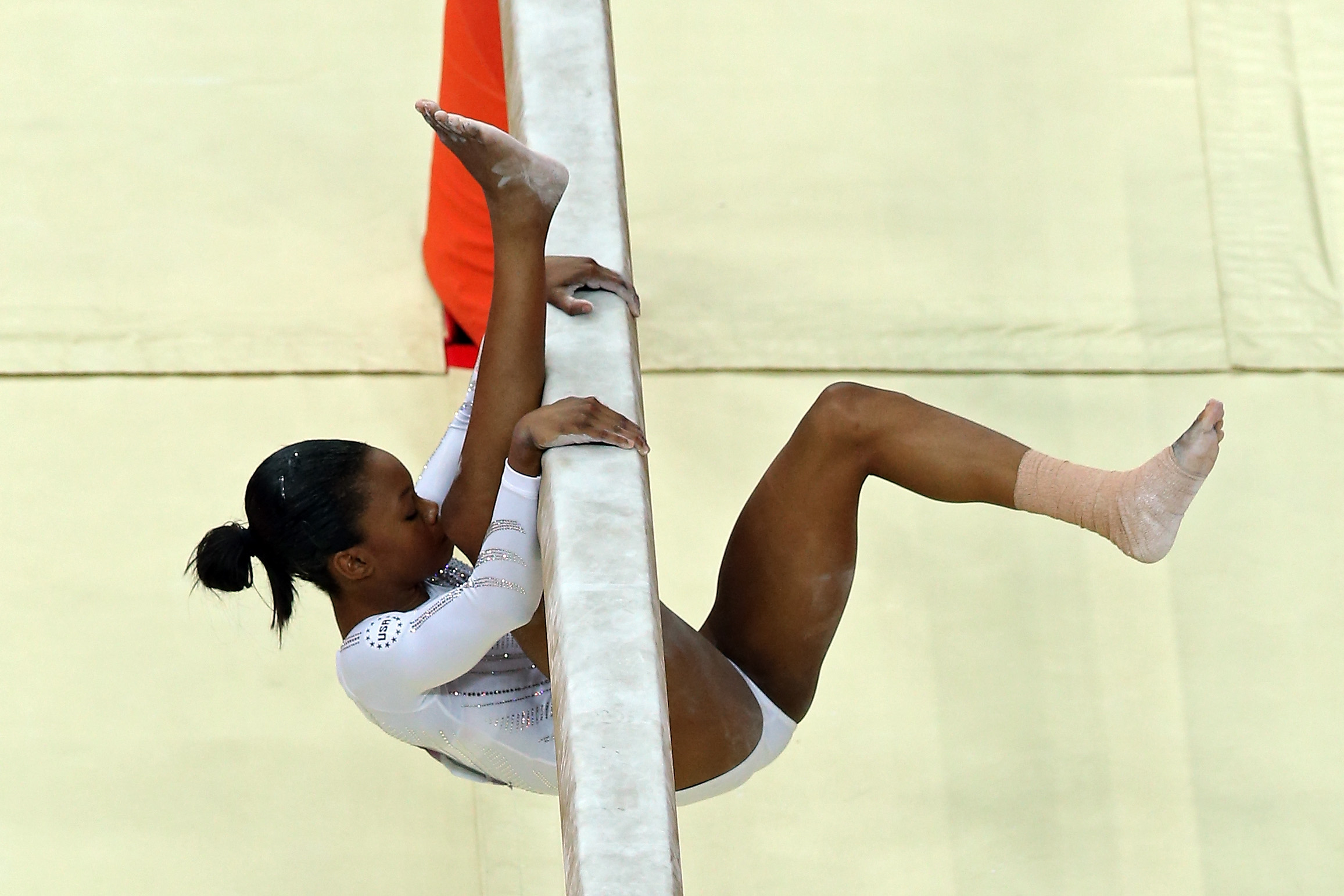
    Someone needs to run that mom the footage of Gabby Douglas clinging to the beam upside down on national TV.

    Photo: Washington Post

    My son plays guitar and drums. Lots of people assume he wants to be a rock star. Even though his heroes include Dave Grohl and Jeff Beck, he has no desire to get on the road or the stage. At a recent Passover, two (middle-aged male) guests couldn’t believe he didn’t want to be the next Jimmy Page. At first, I didn’t believe him either, but he’s said it often enough that I’m not seeing any backstage passes in my future.

    My daughter looks to be passing on greatness for now, too. Watching Aly Raisman nail her floor exercise, she said, “So, if I work hard enough, I could go to the Olympics, too.” “Sure,” I said. She considered the possibility then said, “Nah. Too much work. I want my child years.”

    I don’t mean to imply that my children won’t achieve greatness or that I don’t want them to. Maybe they will but I would like to let go of the idea that they need to shoot for the top in all of their endeavors.  I don’t want to amend my definition of greatness, either. My daughter is right. Achieving greatness takes a lot of hard work, no matter if you have natural talent or not. Elite runners train twice a day, every day. Gymnasts move away from their families and get tutored instead of going to school. Musicians spend hours practicing mind-numbing exercises. All in pursuit of greatness.

    I think it’s great that my daughter loves flipping herself around a wooden beam and running faster than almost everyone in her class. I think it’s great that my son loves music and wants to learn how to play every instrument he gets his hands on. Is there anything of greatness in their flipping, running and playing? I don’t know and I’m working hard on not caring.

    I think it’s great that Nathan Sorell got off the couch and ran. I think it’s great that Nike chose to spotlight a pretty ordinary kid.

    I believe it’s true that we are all capable of greatness, but I also believe that, in some things, being great is enough.