My son likes to think that being born in Chicago at Prentice Hospital for Women makes him a city boy. Never mind that he spent fewer than 24 hours outside of my womb in said hospital. He thinks he’s a city boy and really shines the closer he gets to concrete and smog. So, yesterday we escaped our tract house on the prairie and went into Chicago for lunch. Along for the ride were my nephew, visiting from New York, and a friend of my son’s.
We’re a burger eating bunch and, all pizza aside, Chicago is a great town for a burger. I took a peek at the Chicago Burger Bible website and selected The Lock Down Bar and Grill in Ukrainian Village for our Summer Burger Adventure. I’d never been to Ukrainian Village, though my niece recently moved there. The Lock Down reports showing a different live rock concert video every day and the Burger Bible puts their burgers among the top 10 in the city. It’s a pretty freaking big city, so it’s gotta be a pretty freaking good burger, I thought.
I was right. The burgers are good and they are big! This is not a restaurant review so I didn’t pay much attention to the names of things. I did take pictures before we decimated our meals. Everyone liked their food, but only one of us finished: the quiet, shy guy from the ‘burbs. It was fun to watch my son and nephew, both guitar players, try to name the music playing inside the bar.
Dill Pickle Chips…deep-fried slices of pickle, not potato chips that taste like dill pickles. Tasty, but a little goes a long way.This is “The Bootleg” burger with bacon, kimchi and a fried egg. Reportedly a little on the salty side.
The weather was great—beautiful blue sky and not too hot with a cool (lake?) breeze. The location was perfect—far enough off a busy street to be able to chat but not so far we lost the urban vibe. The company was stellar—people I love who I rarely get to just sit and hang with.
This one’s not on the website menu. Onion rings stacked high over a pile of Gorgonzola. Definitely not edible without a flip-top mouth.For the petite appetite. You can get these babies plain if you’re a kid, otherwise they come in a “flavor of the week.”
My idea of a perfect summer moment. What’s yours?
A rare glimpse behind the scenes at Snide Reply. That’s me in the middle. My nephew, a future Oscar-winning animator, is on my left. Click on his link in the first paragraph to see his work, then hire him. The Viking Lord on the right is my son.
I thought about not posting today. Not just not writing. No guest post; no re-blog. No “I’m taking a vacation, see you next week.” Nothing. See, I spent the week wondering what I would write about the Aurora shooting. It seemed I really should write something about the Aurora shooting. It’s a tragedy and not recognizing it feels callous. Writing about funny things my kids say, weird places my dad thinks he’s been and other trivialities seemed disrespectful.
I don’t believe I’m a callous person nor disrespectful, so then why have a struggled so much to find something coherent to say about what happened on July 20?
Because I’m not surprised it happened. And I’m not surprised at the aftermath. Columbine. Virginia Tech. Northern Illinois. Strip malls. Fast food places. Someone goes crazy with guns. The media goes crazy reporting on it. Some people say we need gun control. Some other people say guns don’t kill people. It goes around and around and nothing changes except the people who die.
I tried to find a place of righteous anger. Nothing relieves a sense of helplessness better than a good head of steam. I couldn’t find a thimble full of steam, let alone a head.
I’ve been a gun-control advocate for a long, long time. When I read the Bill of Rights, I agree with the dissenters in Columbia v. Heller and don’t leave the “well-regulated militia” part out of the Second Amendment. I have no problem requiring guns to be registered. I register my kids for school every year, filling out the same stupid information on the same freaking forms even though none of it has changed from the year prior. Though I firmly believe my children are shortening my life, kids aren’t generally considered lethal weapons. Surely someone wishing to own a gun can endure the inconvenience of registering it.
I have supported handgun bans, too, and certainly got in line to ban assault weapons. Someone wants to rape me or take my purse, they don’t need to shove a machine gun at me or hold a pistol to my head. They’d convince me with a knife. Hell, I’m so small, I could easily be overpowered by just about any determined criminal.
As with all issues that interest me, I researched gun control before forming my opinions. So, when the same old “no guns, yes guns” points and counterpoints got trotted out over the bodies of the Aurora shooting victims, I revisited gun control issues.
And now I feel helpless. We can ban gun sales. We can stop manufacturing guns. We can make it illegal to own guns. (Oh, shut up! Yes, you can keep your rifle for hunting and shooting the heads off home intruders. Tuck it under your bed with your slippers.) We can do all of these things and we will still have too many guns.
We like to say things that will always be with us are like cockroaches. But cockroaches are biodegradable. Guns aren’t. Guns are like pennies. There are billions of pennies floating around the world and unless someone gathers them all up and melts them down, they will continue to float around. Same with guns.
I’ve heard a joke about lawyers that goes something like this: if you took all the lawyers in the world and put them at the bottom of the ocean, what would you have? A good start. If we took all of the guns in America and put them at the bottom of the ocean, I think we’d have a good start, especially if we start with the assault weapons.
But we will never get all of the guns to the bottom of the ocean. We will never even agree that a good number of guns should be at the bottom of the ocean. Until we have the economic, political and civic will to understand that guns and their proliferation are a problem for those who want to own them and those who don’t want anyone to own them, we will be awash in guns and the concomitant violence.
What makes me feel even more hopeless in considering the Aurora shootings is that we need terrible tragedies to force us to consider the consequences of being the most heavily armed society in the world. And such tragedies have little to do with the true costs of having so many weapons so readily available. Someone as clearly unstable as James Holmes would definitely have found a way to make a murderous spectacle of himself whether he did it with guns or machetes.
The highest cost to us of gun violence takes place all day, every day. Caring for a single gun shot survivor—from the time he hits the ER to the day he dies—can cost more than $600,000, not including lost wages and other indirect costs. Gun violence doesn’t just cost us in health care, but in costs for increased security, such as metal detectors; costs to prosecute, defend and incarcerate offenders; and in the emotional and psychic costs of raising children in a violent, unpredictable world.
There is no way to make sense of a heavily armed man walking into a movie theater and shooting as many people as he can. We can spew our entrenched beliefs about guns and gun violence at each other all day, every day and it won’t begin to prevent another James Holmes. In fact, choosing to discuss gun violence only when it is demonstrated in its most spectacular form disrespects all victims, whether they were shot in a movie theater or an alley.
This week, I begin experimenting with my Monday post. I had been posting a link to my Naperville Patch column. In a sign of the times, the Patch is no longer carrying opinion pieces written by people with, you know, opinions. Said people like to be paid. Said news source figures they can get people to write blogs for free. I have, indeed, gone to the dark side and agreed to write a blog on the Patch covering the same topics I did in my column: parenting and suburban life. For now. But that doesn’t mean I have to send y’all to the Patch! Oh, no, no! You can read my excellent verbage here. Benefit to you? I leave in the snarky, nasty bits I can’t really put on a family media outlet. Enjoy!
Maybe you’ve seen them. The Proctor and Gamble “Thank you, Mom” commercials showing moms around the world getting their little athletes out of bed, shuttling them to lessons, washing out their work out gear, biting their nails at meets—all so the tykes can grow into Olympic athletes? Another shows athletes arriving and competing at the Olympics and each athlete is portrayed by a child ‘cause “in their moms’ eyes,” the ad states, “they are all still kids.” The spots have gone viral on the Internet primarily because they’re real tearjerkers.
They make me cry, too, but not only because of their sentimental portrayal of the sacrifices moms make for their kids. I’m saddened the whole campaign focuses on moms as if they are the sole reason athletes are able to rise to the pinnacle of their sports.
Tell that to Apolo Ohno, raised by a single dad who juggled 12-hour shifts at his hair salon with caring for his infant son. Dad got Apolo into competitive swimming and inline skating to keep his son from becoming a latch-key kid. When Apolo switched to speed skating at 12 years old, his father drove him to competitions throughout the US and Canada then got him into the Lake Placid Olympic Training Center at 13. Apolo is the most decorated American Winter Olympic athlete in history.
Gymnast Nastia Liukin and tennis player Serena Williams are coached by their fathers. Ireland’s Katie Taylor, also coached by her father, is following in his footsteps; she’s the world women’s boxing champion.
Virtually assured of a slot on TeamUSA in 2016 is 13-year-old diver Jordan Windle, who nearly qualified for the 2012 team. Jordan, adopted from Cambodia at age two, will have two dads to thank should he achieve his dream.
I have nothing against giving mom a pat on the back but the P&G spots make me queasy reinforcing, as they do, the idea that raising children is a woman’s job. My nausea is increased as I watch the P&G moms doing the laundry, washing dishes, shuttling kids in their big fat minivans. Yeah, someone has to drag the cranky, sleepy future Olympians out of bed but in our house it’s Mom during the week and Dad on weekends ‘cause, you know, we both work. Good luck finding a mom doing anything but home and kid care in these spots. And dad? The only one you’ll see is sitting on his butt watching his daughter on TV.
Twenty-four percent of children in the United States are being raised by a single mother. Abundant research shows the presence of responsible, involved fathers reduces poverty, prevents child neglect and abuse, increases child health and academic performance and decreases discipline problems, among many other benefits. In that light, leaving dad out of the picture in an advertisement seems irresponsible at best and dangerous at worst. P&G claims it is the “proud sponsor of moms.” How hard would it have been to be proud sponsor of parents?
The P&G commercials are fictional dramatizations of idealized moms. If you’re still looking for an Olympic moment that will bring tears to your eyes, look back to 1992 when British runner Derek Redmond tore a hamstring muscle in the 400 meters. In pain, he hobbled to the finish supported by a man who ran onto the track from the stands—his father.
Karin Evans, Dr. Evans to her students, is a professor of English and long-time friend. She wrote today’s post, about teaching writing at the college level to students who don’t pass the placement exam for the college’s freshman-level English class. She’s doing such difficult and important work. Need persuading? Try to teach someone to write. Enjoy!
I teach writing at a two-year college with open enrollment, where many students are placed in “developmental” classes to help them catch up to college level in reading, writing, and and/or math. When I tell people what I teach, they often ask me why students who have graduated high school need to take these extra classes. Here are four stories about why.
Matt, who writes like he talks. Matt sits in the back, in the corner, a skinny young guy in a baseball cap. Matt is having a hard time reconciling his own style with how I want him to write his essay. Matt writes extremely casual prose. He writes “alot,” a lot. He never bothers to capitalize the pronoun I. In his concluding paragraph, he uses the phrase “i mean yeah” to create emphasis in the middle of an important run-on sentence. The niceties of Standard English are completely absent from his work. However, he clearly understands the assignment, and the ideas in his draft are completely relevant – it’s a diamond in the rough.
At the end of the semester, Matt does not pass the exit exam. I am not surprised. I meet with him and we discuss some options, decide that he will take a one-credit class to keep working on his writing style before he tries the placement exam again. I pray that he will meet a creative and flexible instructor for that one-credit class, and that he will have courses in other subjects with manageable writing assignments. Matt’s understanding of what college will ask of him is growing – I hope he can catch on fast enough, that his good attitude and intelligence will be enough to carry him through.
Jonie, who doesn’t have 100% to give. Jonie is pretty, nicely dressed, and quiet. She is often absent, and often does not submit homework. When she attends, she does well in class – but she does not progress as well as she should be able to. She is elusive; she does not seek help or respond to my comments on her work. After failing the exit exam, she comes to her scheduled conference.
Sitting in my private office, Jonie confides that she was in a serious car accident the previous year and experiences back pain and neurological problems, including uncontrollable facial and body tics. She has frequent medical appointments. These conditions cause her a great deal of stress, and some days she is simply unable to make herself come to school. Compounding these more unusual problems, she does not have good study habits, struggles to manage her school assignments and deadlines. Jonie tells me candidly that she does not feel she has earned her way into English 1101; she believes she would benefit from repeating the developmental class. I am both impressed and relieved that she has drawn this conclusion for herself. But will she persist, and enroll in the class again? Then will she find the support and motivation she needs to do better the second time?
Jeremy, a little older and wiser. Jeremy has been a forklift driver, a security guard, a warehouse shift supervisor. Now about 30, he is a husband and a father. His wife has more education – I have a hunch that she latched onto him because she could see how smart he is, how engaged and determined. Jeremy is opinionated and verbose in class discussion. Somehow I am able to help him channel and structure all his ideas and energy in his writing. In one semester, his writing transforms from halting and underdeveloped paragraphs to fairly articulate and detailed essays.
Jeremy passes the exit exam, as he deserves. The following semester, he stops by to let me know how his English 1101 class is going and to show me a picture of his new daughter. Last week, he emailed me to ask about the required textbook for my online English 1102 class – he’s enrolled.
Austen, who is really ready to learn. Like many developmental students, Austen attempts the placement test more than once before giving in and enrolling in the course. She writes in an early assignment that she has never done well in English and figures that she’ll be better off if she takes the class. Austen is a teacher’s dream come true – she follows instructions, works really hard on her assignments, takes feedback well, and sets an excellent example for other students.
Nervous about the placement test, Austen asks me what will happen if she fails. I say we’ll drive off that bridge when we come to it – but I know I am already committed to walking her through an appeal process if it comes to that. Sometimes really good students freeze under pressure. I tell her that as long as she remembers to take her confidence with her, she’ll do fine – and she does.
You might be asking, did Austen really need that extra class? Maybe, maybe not – but according to her own self-report, she was glad to have the chance to build her confidence before taking English 1101. I’m not worried about whether she will pass English 1101 now, and I hope she’s not either.
Why do we offer developmental education for students like these in the college setting – why don’t the high schools finish the job? High school is for children, who are subject to their parents and the state. Developmental education belongs in the college setting because the students are adults, and college is where we educate adults. Adults choose and prioritize their own goals, and they figure out how to reach them, or they figure out how to change them. Frequently, people who did not sense any real purpose for their high school education, or whose experience was compromised by abuse, poverty, mental illness, or any number of frightening factors, find themselves ready, in some ways, to approach college. They may be socially and emotionally mature enough, and they may be perfectly intelligent, but their academic skills may be lacking.
There is no format in the high school setting where adult students can be served. However, colleges – especially community colleges – are well suited to meet the transitional needs of adult students. Our developmental classes are tied into the college curriculum; most faculty also teach college-level courses. Our classrooms are college classrooms. For many students, we offer an essential bridge to the path that leads to a significant goal – a nursing degree, a program in video game development, a certificate in construction management, transferring to a four-year university to study computer science. When we invest in these students, we invest in ourselves. We educate citizens and professionals who will make a difference in the lives of many. In the long run, these are the best investments we can make.
Any ideas on what I should publish on Mondays from now on? Parenting tips? Rants? Recipes? Funny things my son says, which would have to be heavily redacted?
You would have thought I was negotiating to form my own drug cartel, what with the references to automatic weapons, marijuana and LSD. Throw in the odd request to stop at Burger King to appease a serious case of munchies and it’s no wonder I was feeling a little like I’d been dropped into an Al Pacino movie.
The conversation up front was all about allowing incense burning in our house. I graduated from high school in 1976. As I told my son, “I know about incense! First it’s incense and then it’s marijuana and pretty soon you’re a has-been rock star chatting about your dysfunctional family with Dr. Drew.” Ok, maybe I didn’t really say that, but only because I was interrupted by my daughter, who wants a gun.
I was prepared for the conversation with my son. I’ve lived through decades of don’t-do-drugs messages. It started with my mom saying, “Don’t do drugs,” rolled through “this is your fried egg on drugs,” then it was “Just say ‘no’ ” and I’m now firmly established in “Parents: the anti-drug” territory. As an anti-drug, I am supposed to be a powerful force in preventing my son’s appearance on Celebrity Rehab.
I am finding, though, that the anti-drug, like all things good for you, is best taken in small doses. So, the drug talk is a hit and run operation. I wait for an opening, drop in a “don’t do drugs because blah, blah, blah” and move off the topic. I have a short list of reasons for not doing drugs and I rotate them. One day I might use, “Drugs are illegal and you’d be eaten alive in jail.” Another day it might be, “Drugs impair your judgment. Just look at what the hippies wore!” Frequently, it’s “If you die stupid, I won’t go to your funeral and I’ll cry forever.” This one is particularly useful when a celebrity dies stupid.*
The incense issue came to the fore over a video game tournament my son has planned. My son isn’t big on organizing events, so when he decided an all day Zelda marathon was the way to while away the summer, I was onboard. Bewildered, but on board. Each of his friends was assigned an iteration of The Legend of Zelda that he would play through while the others watched. One friend wants to burn incense to “help him concentrate.” I try not to judge, but as the anti-drug, I am highly attuned to disturbances in my son’s force field. This friend is also enamored of the Beatles’ Maharishi Whatshisname period and wants a sitar.
So, it was easy to just say “No” to the incense. The Zelda marathon will go on, but there won’t be anything other than Axe body spray hindering my pot-detecting senses.
That brings us to the gun.
There are certain conversations you expect to have when a daughter comes into your world. There’s the one about how it isn’t nice to chase the boys and kiss them when they don’t want to be kissed. There’s the one about strangers with puppies. A little later, there’s the one about bra-lettes. And a little later than that, there’s the one about, you know, THAT.
I never expected to have a conversation about guns with my daughter. I know, shame on my feminist self.
Seems all the girls have guns now. Nerf guns, that is. But my daughter won’t be content with the little manually powered pump action gun. See, my daughter aspires to be a ninja like the ones in those bad Asian action movies. She’s already well on her way. Combining her gymnastics training with a friend’s Nerf gun, she’s turned target practice into something out of The Matrix.
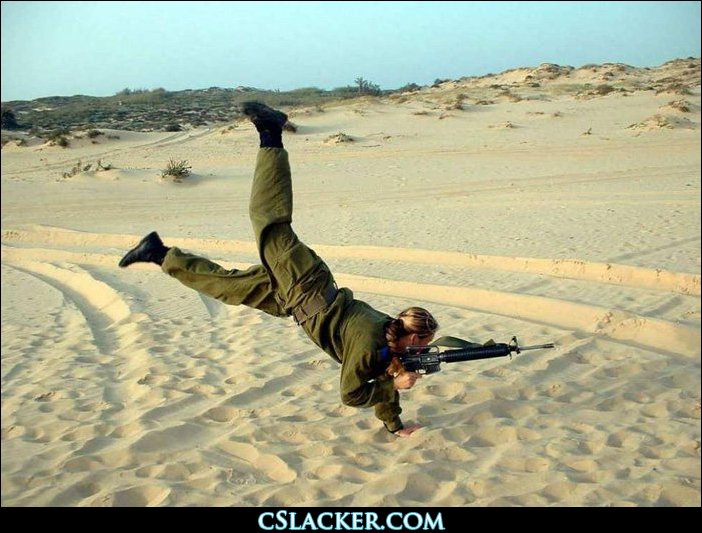
She’s very good, she assures me, at performing a cartwheel, friend’s Nerf gun in hand. On landing, she executes a perfect bull’s eye into the target. The pump-action model is holding her back, though. “I have to stop and pump it up to shoot again,” she complained. The ideal gun, she assures me, will allow her to execute cartwheel after cartwheel, shooting all the while.
Her dream gun is the NERF™ Dart Tag Swarmfire Blaster. It has “a full-auto 20-dart attack! . . . and a rotating barrel for rapid blasting and a removable stock for high-mobility attacks!” Obviously, the euphemistically named “Blaster” also comes with lots of exclamation marks.
This cartwheel/weapon maneuver could well prepare her for a career in the military.
Here’s the fly in my daughter’s machine gun ointment, though. It will be a cold day in hell when I buy her a gun of any kind. And it will be a colder day when I let her sign on for a tour of duty. It’s not just the getting killed in action—or inaction—that scares me. It’s the fact that she’s more likely to be raped by her comrades than killed by any foreign enemy. Just for the record, I took the same stance with my son. No guns; no military duty.
Anticipating outrage from several quarters, I do not in any way believe that military service is not honorable. My dad and brother served and my niece is in the Navy. I realize, too, that my kids could die any day by just about any means. Still, I’m not out there pushing them in front of buses just to tempt the fates.
So, there will be no guns and no incense. Peppermints might be nice, though.
* Dying stupid includes: suicide with or without weapons, accidental overdose, accidental overdose involving either of the Olsen twins, aspirating vomit, driving cars into solid objects, stepping in front of buses, getting involved with drug addicts and being accidentally killed, allergic reaction to burning incense, choking on sandwiches, etc.
Yesterday, I wrote in my newspaper column about spanking and the fact that it, quite literally, can drive your kids crazy. Well, I stirred a little nest, I guess. I’ve been berated for humiliating my children and been informed the spanking can be appropriate. What do you think?
My husband and I were doing something we frequently do together at home, fretting over the economy and trying not to spiral down into the deepest pit of depression where we decide it’s better to curse the darkness than light a single candle. The kids were around but I figured they were oblivious. They ignore us when we are talking to them, why wouldn’t they ignore us when we aren’t?
I realized that my daughter wasn’t just occupying the same space when I asked my husband, only half rhetorically, “How did we get here? How did the country get so screwed up so quickly?”
And my daughter said, “Obama.”
My brain did a whiplash U-turn from “Poor us! We’re going to hell in a hand basket” to “Who the hell told you it’s all Obama’s fault?”
“Who told you it’s all Obama’s fault?” I asked.
“Oh,” she giggled nervously, “he’s just the only one in government that I know.”
Skipping over the part where the federal government is completely responsible for everything wrong in my country presently, I said, “That’s the only person in government you know? What about your governor? Didn’t they teach you who’s Governor of Illinois?”
She avoided my gaze, shrugged her shoulders and asked, “Sarah Palin?”
“What!?” I asked? “Why would you think that Sarah Palin is Governor of Illinois?”
“That’s the only other name I know,” she said, laughing. I wasn’t sure if I should be relieved that Sarah Palin isn’t our Governor or appalled that my daughter doesn’t know anything other than Barack Obama is our president and therefore responsible for all that is wrong in it. This, after just completing fourth grade where the civics units covered the United States government.
Thinking my son might be a little more knowledgeable about his country’s government, I asked him who the Governor of Illinois is.
“Blagojevich?” I gave him points for naming someone who actually held the office, then probed his knowledge of our judicial system. I thought he might be able to name a Supreme Court justice or two since we’re on the heels of a significant and widely reported decision.
“Name a Justice of the Supreme Court,” I said.
“The Justice League?” he suggested.
I knew my country was filled with civic ignoramuses, but I didn’t know I was raising some. Our dinner table conversations aren’t always politically tinged, but my husband and I talk about all of the day’s news, not just how Katie Holmes should have seen it coming. That means Supreme Court decisions, drone bombings, Finnish family leave policies and the presidential election are hanging out there with who wants to see Brave and whether or not our son can go bowling that night.
American ignorance is legendary. I don’t need to recite the figures. You can read them here. We are the country, after all, that went to war in Iraq, looking for weapons of mass destruction that didn’t exist.
We are the people who demand more and more cheaper and cheaper stuff, then complain when the manufacturing jobs dry up and move where people will work for less than we will.
We are the people who are willing to send our sons and daughters to pay in blood for freedom around the world, but won’t pay an extra penny in taxes to pay for their deployment.
My vexation sloshes over onto Facebook, where I regularly correct people who post memes declaring that kids can’t pray in school or recite the Pledge of Allegiance. I’m tired of explaining that it’s perfectly ok to cross yourself before a test and pray you get a good grade, but it’s not ok for the teacher to cross herself before a test and lead the class in prayer. I’m tired of explaining this to people who would be first in line at the principal’s office if a student did her private prayer on her knees and wearing a hijab. I’m tired of explaining this to people who wouldn’t want their child taught by a teacher who doesn’t recite the Pledge of Allegiance because of the “under God” part.
Yes, I realize I sound tremendously judgmental and arrogant. I can’t help myself, though, because I love my country and the principles on which it was founded. I love our get-it-done approach and our generosity. I even love our naïveté, the way so many of us think that if you can dream it, you can be it. We’re the Nike country, ignoring the subtleties and attacking every problem with a “Just do it” bravado. But we’re youngsters, isolated for so long, and now more than ever immersed in world of interrelated complexities.
We went to the fireworks this year with our daughter. In our town, one of the local radio stations puts together a soundtrack to play along with the display. Lots of people watching the fireworks with us had tuned to that station, so we were all listening to the medley of America-themed songs, from Born in the USA to David Bowie’s Young American. When they got to The Guess Who’s American Woman, I leaned over to my husband and said, “Do they know this is an anti-America song?”
Read the other posts, too. The man who started the blog is also dealing with a son with ADHD and the meds that come along with it. And there are others who posted as well. It’s a valuable, developing resource for those of us taking drugs with black box warnings (means they can lead to all kinds of nasty side effects, like suicidal ideation and other fun things) and parenting kids taking those drugs.
It’s Father’s Day. I’m sitting with my Dad on the patio.
“How are you, Dad?” I ask.
“Not very good,” he says, looking down at his hands. I’ve never seen him this sad.
“Your mother rejected me,” he says and tells me, through tears, that my mother left him.
I start to cry, not knowing which is worse, telling my father that my mother died nearly four years ago or letting him believe she’s still alive and left him.
“Dad,” I say, as gently as I can, “Mom’s dead. She died almost four years ago. She would never leave you.” He looks up, confused. He’s confused nearly all the time now.
“You took such good care of her, do you remember that?” He’s trying. “She had emphysema and you took such good care of her. She was just too sick. We had to let her go, Dad.” I wonder if he remembers making the decision ending life support. He believes me. He believes and he’s sad, but he’s calmer.
I visit my dad every week these days, but I never know where it’ll be. Last week, it was Denver. He was waiting at his hotel, while my mother and grandmother shopped for houses. They’d come to Denver for a convention, something they did a lot. Traveling to conventions, that is, not traveling to Denver. He seemed anxious about buying yet another house, but he’d never really been able to say “No” to my mother. I told him I knew the feeling.
Another visit saw us in Hong Kong, having dinner with a group of executives my dad clearly didn’t like because they’d kidnapped me. Yet another visit saw us in Rochester at a bicycle factory. There was our visit in an undisclosed location in Romania, where my dad told me he was forced to sit on a minaret to escape the men trying to capture him in Saudi Arabia. Recently, my sister married the Shah of Iraq, so we have an Arabian theme going lately.
My dad’s delusions are nothing compared to the other residents. There’s the woman who gathers all of the baby dolls and stuffed animals and arrays them on a table. She dresses them all and sets them down to sleep then complains about how she has so many babies to care for. There’s the 105-year old woman who was once a singer. She still tries to sing but it comes out as screeching wails. There’s the woman who sits quietly and, when she catches your eye doesn’t say “Hello,” but “I’m afraid.” “Afraid of what?” I asked. “Of dying,” she replied.
It’s hard not to make the leap to The Snake Pit or One Flew Over The Cuckoo’s Nest or whatever look-inside-the-loony-bin movie was popular in your particular generation. This, after all, is what crazy people are and do.
But I know better. My father and his housemates aren’t nuts. They have a terrible disease that literally eats at their brains, destroying the web that connects a lifetime of accumulated memory and leaving them with a stew of thought they continually try to make sense of.
No. They are not crazy; I am. At least, that’s what my society says. I have bipolar disorder; I am bipolar. I never know which description to use, so I use both. But no matter how I reveal my condition, I get a universal reaction, spoken or no. “That chick is crazy.” Someone even told me, “Wow. You’d never know to look at you!”
I suppose that’s a compliment; the self-harming, judgmental thoughts, over-spending and insomnia don’t show on my face. Of course, the medication helps. More likely, it’s an indication of how crazy Americans are about mental illness.
I happen to come from a family of crazies. Alcoholism, schizophrenia, drug abuse were things I learned about early. None of the crazies looked crazy. Well, ok, the schizophrenic lived in another state, so I didn’t see him very often and can’t really say he never looked crazy. Still, “you’d never know to look” at any of them that they lived with demons.
So, I don’t usually tell people I’m bipolar, though I’ve been doing it more often lately. Maybe it was the “you don’t look” it comment; maybe it’s my own growing acceptance. I’ve been more active in the blogosphere lately and the anonymity it affords makes it easier for crazies to hang out and connect with each other.
In America, you can pretty much tell who’s a flag-waving conservative by, well, the flags waving on their houses. I decided, some time ago, to take back the flag. This is my country, too, I thought, and hung the flag on our porch.
So, I’m taking back crazy. I’m a mom, a writer and a teacher. I have two great kids and the obligatory pets that go along with living in one of America’s most famous suburbs. I’m happily married.
















 Snide Reply