Category: Holidays

  • Step right up and get your grievances!

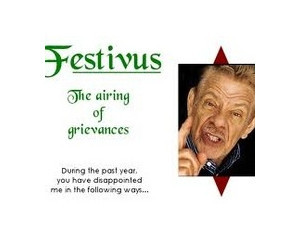
    a6d4a0d43dbea0d42f5d672a570a21e7Once upon a time, I was a loyal Seinfeld viewer; I’m still known to say, “No soup for you!” But eventually, Elaine Benes wore me down. Unable to take anymore of her self-involved whining, I stopped watching. This explains why I am probably the last person in my blogosphere to know about Festivus, the holiday for the rest of us.

    While I come to the Festivus party late—far too late to be fashionable—it seems to be a holiday tailor-made for me. Among the holiday’s traditions is the airing of grievances. In my mind, grievances call for a rant, and I do so love a rant, so here we go!

    Stop saying you’re “so depressed” when you’re sad. Depression isn’t just being sad. Depression is being unable to get out of bed, thinking the world would be better off without you, wanting to just fade away. Depression is sitting on the couch convinced that life is pointless, not sitting on the couch eating a quart of ice cream crying. Sad is painful but knows that life will get better; depression doesn’t.

    If I promise to only use the term “ big beautiful woman” to refer to big beautiful women, can we promise not to call thin women “skinny bitches?” Really, why is it any more politically correct to malign the thin than the overweight? See? I can’t even bring myself to type the f-word, the one that rhymes with “cat,” not that other one.

    No more tailgating. Just no. Never. Ok? I sort of understand it in the far left lane on the highway. But in my neighborhood? Where the speed limit is 40 mph? And there are children and golden retrievers running into the street chasing after soccer balls? I’m gonna brake for Lassie, butthole, so just keep your Hummer off my tail.

    Christmas lights! Stringing five different colors of lights end to end and then hanging them in a straight line that extends from the edge of the garage, over the top of the front door and then drapes across the row of hedges in front of your living room windows is not decorating. It’s not even redneck; it’s not even Honey Boo Boo redneck. And a string of lights is not an extension cord. We clear on that?

    Everyone in my family who empties the kitchen trash: put another bag in the can. And, if you don’t, you don’t get to laugh at Mommy when she swears after dropping a handful of disgusting into the unlined can.

    While we’re on family issues . . . darling children, why should Mommy help you clean the toxic waste dumps you call your rooms? You have no idea how little I care if you can’t find your panda pajamas or the T-shirt that your girlfriend likes to wear because it smells like you.  In my time, mothers closed the door on their children’s messes. I am not about to dishonor my mother’s advice and she’s dead so she can’t tell you that her mother cleaned her room every day. I am nobody’s grandmother, though you love reminding me that I’m old enough to have birthed half of your friends’ parents. By the way, this does not make Mommy want to clean your room, either.

    And last, but not least, can we put the Christmas/Xmas/Holidays thing to rest? Nobody’s trying to take the Christ out of Christmas by using Xmas. Actually, didn’t Christmas start out without Christ in it? So really, were putting Christ in Christmas every year. I’m just sayin’.

    That brings us to holiday greetings. Can’t say “Merry Christmas” because it tends to leave out the people who celebrate Hanukkah, Diwali, Kwanza, though I’m not sure that’s supposed to be “merry” so much as meaningful. There’s “Happy Holidays.” While it’s inclusive–probably too inclusive for atheists–it’s kind of wishy-washy. Naturally, we could say “Happy Festivus” but I’m pretty sure that leaves more people than in includes. Besides, most of my friends would just look at me with a blank stare. Okay, I’m kind of used to that, but I don’t like to knowingly solicit it.

    I was going to propose we say “Peace be with you,” but that reminds me of that oh-so-uncomfortable moment in church services where you are forced encouraged to greet the people around you. If I wanted to say something to them, I would have. Don’t make me clasp their hand and try to say something sincere when all I can think of is the germs that are getting spread at the height of flu season.

    I don’t like to point out a problem and not have a solution, but I don’t have anything witty or profound to say in place of “have a good one” during the holiday season. But I have a great idea for what to think:

    Peace on Earth, good will to all. May you live in safety and be happy.

  • It’s beginning to look a lot like Hanukkah

    It’s Christmas time! That holly jolly time of year that we await eagerly. Houses are decked, trees are lit. Children are half out of their minds with anticipation. Radio stations play carols around the clock. Every night, there’s another holiday special to watch.

    And every year, Christmas makes me glad there is Hanukkah.

    Hanukkah really shouldn’t be compared to Christmas but they happen at the same time of year so I guess it’s inevitable. Hanukkah is a minor holiday in the Jewish calendar, not like Yom Kippur, which is the heavyweight. Someone joked once that many of the Jewish holidays follow the same theme: “They tried to kill us; we won. Let’s eat.” Hanukkah is one of those holidays.

    Christmas exhausts me.

    I start thinking about Christmas gifts for friends and family some time in August. I do this not because I’m particularly organized, but because I can’t afford to make the entire Christmas sacrifice in a single month.

    Hanukkah? We don’t do gifts at Hanukkah.  I tried doing treats for each night when my son was very young. Every night, he got some dumb little thing. On the ninth night at sundown, he said, “Where’s my present?”

    Since then, the kids have had parties for Hanukkah; one year we made pretzels. This year, we’ll have a small dinner party with brisket and latkes. I might even make rugelach. I will make this dinner once, even though Hanukkah lasts eight days. My daughter is inviting her best friend. My son is inviting his girlfriend. My daughter’s friend is invited to sleepover, too. My son’s girlfriend is not.

    Christmas decorating takes three days, but it takes me at least three weeks to build up the momentum to accomplish it. I keep all holiday decorations in big plastic bins in the crawlspace. Halloween has a bin, as do Passover, Easter and Chinese New Year. Christmas has eleven bins, not counting the box—large enough to hide a small body in—that contains the Christmas tree.

    It takes at least four trips up and down the stairs from the basement to get all of the Christmas gear into the living room. Two people are needed to move the casket tree box. Every year, I’m afraid my husband or son will go tumbling down the staircase should the tree moving go horribly wrong.

    Because my husband is Jewish I’m a control freak, only I can put the lights on the tree. It takes me at least three hours, after which my arms are shredded from winding strands of lights in and out of the tree’s branches. I always have either too much left when I get to the top, or too little. It can take me half an hour to get the top of the tree lit to my liking.

    The next day, I put the ornaments on the tree. My daughter helps; my son says he does, but I can’t recall this phenomenon. Maybe this year, I’ll take pictures. My son’s greatest contribution to Christmas decorating is his insistence that my daughter and I cease listening to carols while we decorate because, as he says, “Christmas music is crap.” I respond with “Yes, of course it’s crap! But it’s Christmas crap. How else am I going to get in the mood to spend three days decorating the house?”

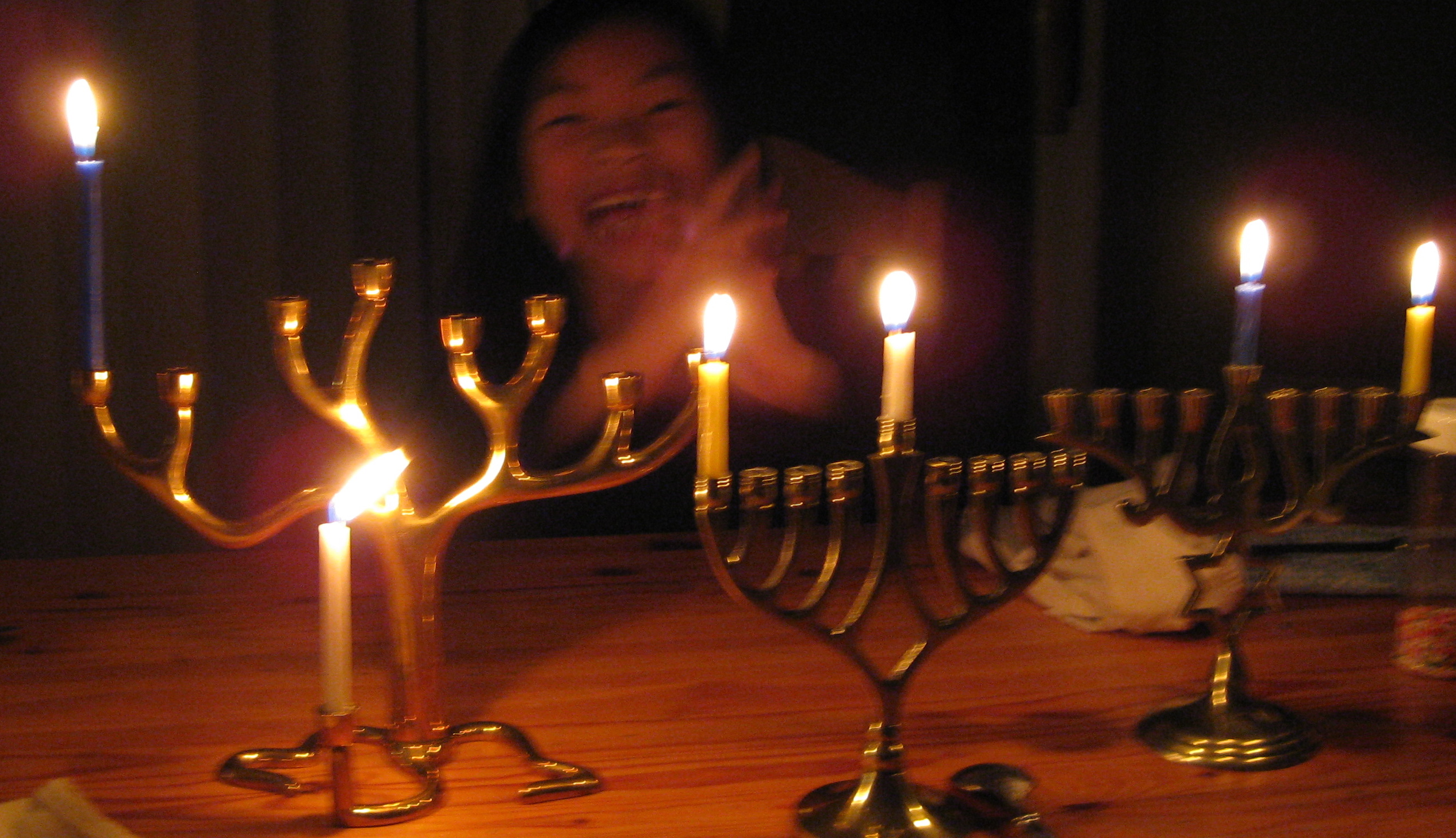
    Decorating for Hanukkah? I bring the Hanukkah box up from the basement by myself. I take out the menorahs; we have one big family one and the kids each have their own. It is necessary for each child to have their own or Hanukkah turns from the Festival of Lights, to the Festival of Whining That He/She Lit The Shamash Last Night.

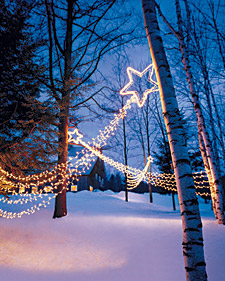
    The extent of my outdoor Christmas decorating is hanging a festive wreath on the door. My inner Martha Stewart demands that an outdoor light display be artistic and neatly applied. This is impossible to achieve unless you are, indeed, Martha Stewart assisted by Santa’s Elves.

    Photo: Martha Stewart Omnimedia

    Hanukkah display? I’m all over that one with our driveway menorah. We start with one luminaria at the end of the drive near the house. Each night, we add another luminaria until, on the eighth night, there are eight luminarias lining the drive. It’s artistic, it’s neat and it’s easy.

    I only have two problems with Hanukkah. Though we start the holiday with the best of intentions—that we will light the candles and say the blessings every night—invariably, we forget at least once.

    The other Hanukkah problem is a matter of timing. Because it’s based on the Jewish calendar, Hanukkah wanders all over December from year to year. Every year, I check the calendar and every year that Christmas minds its manners and stays away from Hanukkah, I breathe a sigh of relief.

    I love Hanukkah because, like Christmas, it brings light to the darkest time of year. But more, I love Hanukkah because its more low-key festivities help me ease into the holiday spirit. This year, Hanukkah begins at sundown on December eighth. We’ll light the candles for eight nights. Then on December 17, I’ll polish the menorah, put it back in its velvet-lined box and be ready to begin the hoopla that is Christmas.

  • Welcoming thanks

    Welcoming thanks

    It’s half way through November and it’s happening again. People all around me are grateful. I have friends who post daily what they are grateful for, everything from goofy co-workers to post-workout meals to husbands returning from out of town trips. One friend is even expressing her gratitude in haiku, but she’s an English professor, so don’t hate.

    I asked my grateful friends why they are making these daily gratitudinal adjustments. They said things like, “Gratitude frees me to be a more hopeful, kinder person.” The haiku-writing professor likes being reminded, “to appreciate what I have. I like the daily Facebook project because doing it every day makes me notice the little things. They kind of turn out to be the big things, so I enjoy that irony.”

    This professor predicted that I would find all this gratitude annoying. She is right, which is also annoying.

    We owe our current focus on thankfulness to the positive psychology movement. Sometime around 2000, researchers found that feeling grateful had a strong and direct correlation to happiness. According to my extensive research on Wikipedia,

    Grateful people are happier, less depressed, less stressed, and more satisfied with their lives and social relationships[19][22][23] Grateful people also have higher levels of control of their environments, personal growth, purpose in life, and self acceptance.[24] Grateful people have more positive ways of coping with the difficulties they experience in life, being more likely to seek support from other people, reinterpreted and grow from the experience, and spend more time planning how to deal with the problem.[25]

    That all sounds good, and like all things good, it gets perverted.

    Corporations get hold of gratitude research and suddenly you’re getting phone calls during dinner thanking you for buying a new dishwasher. Turns out that you’re 70 percent more likely to buy from that dishwasher dealer again if you’re thanked than if you aren’t. My favorite corporate perversion of gratitude is the tech support person who thanks me for calling to report my problem then asks how she can give me excellent service. I’ve never said, “Hm. Well, how about making a product that always works so I don’t ever have to make you grateful again?” I’d be grateful for that.

    I’ve frequently been accused of over-intellectualizing and seeing conspiracy around every corner. This is why I keep Professors among my friends. Not one has ever accused me of over-intellectualizing. In fact, I’m quite the lightweight in intellectual terms. So, I know none of them will roll their eyes when I opine that gratitude is the new opiate of the masses.

    Constantly being exhorted to be grateful for what we have here and now smacks a little too much of the same philosophy that keeps all disadvantaged peoples happy where they are. Add to the “be happy with what you have” message another one promising reward in the future for contentment today and you’ve got a pretty good recipe for enslaving whole groups of people.

    Saying “Thank you” implies that something has been given and while I firmly believe that we should be thankful for our blessings, gifts, or whatever you want to call them, the focus is still on what we have. Gratitude gurus and others selling gratitude keep us caught in the goodies game by having us chasing after more and more gratitude. Now we have to ask not just have we been grateful, but have we been grateful enough. The more grateful we are, the more we will have to be grateful for. It is an infinite loop of gratitude.

    And it makes me feel that we’re missing something. When I was a kid, my mother taught me that the proper response to “Thank you”, is “You’re welcome.” But we’re so driven to thanks, that hardly anyone says “You’re welcome” anymore.

    These days, the answer to “Thank you” is “Thank you.” I noticed it first in radio interviews, where the host thanks the guest for appearing and the guest thanks the host for hosting. They sign off the same way, thanking each other until every reason for the two of them existing in the same space at the same time—even though it is their jobs to do so—has been thoroughly thanked.

    I know my “welcomes” are fewer and I’m betting yours are, too. Listen to yourself the next time you pay for something. The clerk thanks you as she hands back your change; you thank the clerk as you accept it. Hell, I even say “Thank you” instead of “Goodbye” when ending a phone call sometimes.

    But what difference does it make if we say “You’re welcome” when we are thanked or if we respond to thanks with more thanks. Aren’t we still spreading the love?

    “Thank you” is all about getting goodies, even if, as is the case with getting change back, they are goodies that are yours to begin with. “You’re welcome,” in comparison, is about giving. When we say, “you’re welcome” we acknowledge thanks but avow that there is no indebtedness, nothing to pay back, no need for gratitude at all. “You’re welcome,” opens our lives to a more authentic feeling of bounty. I don’t just give to you; I welcome you to take from what I have.

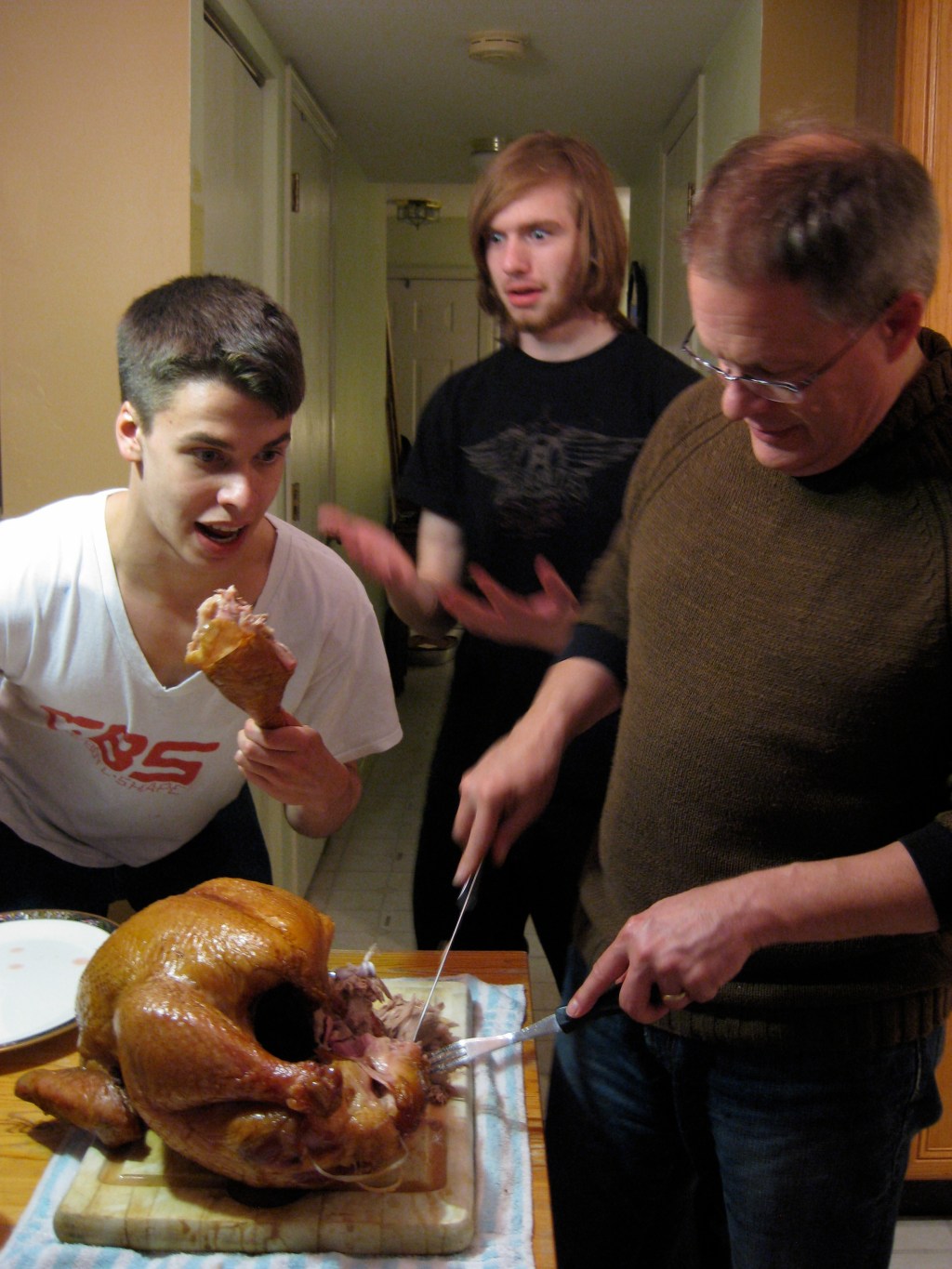
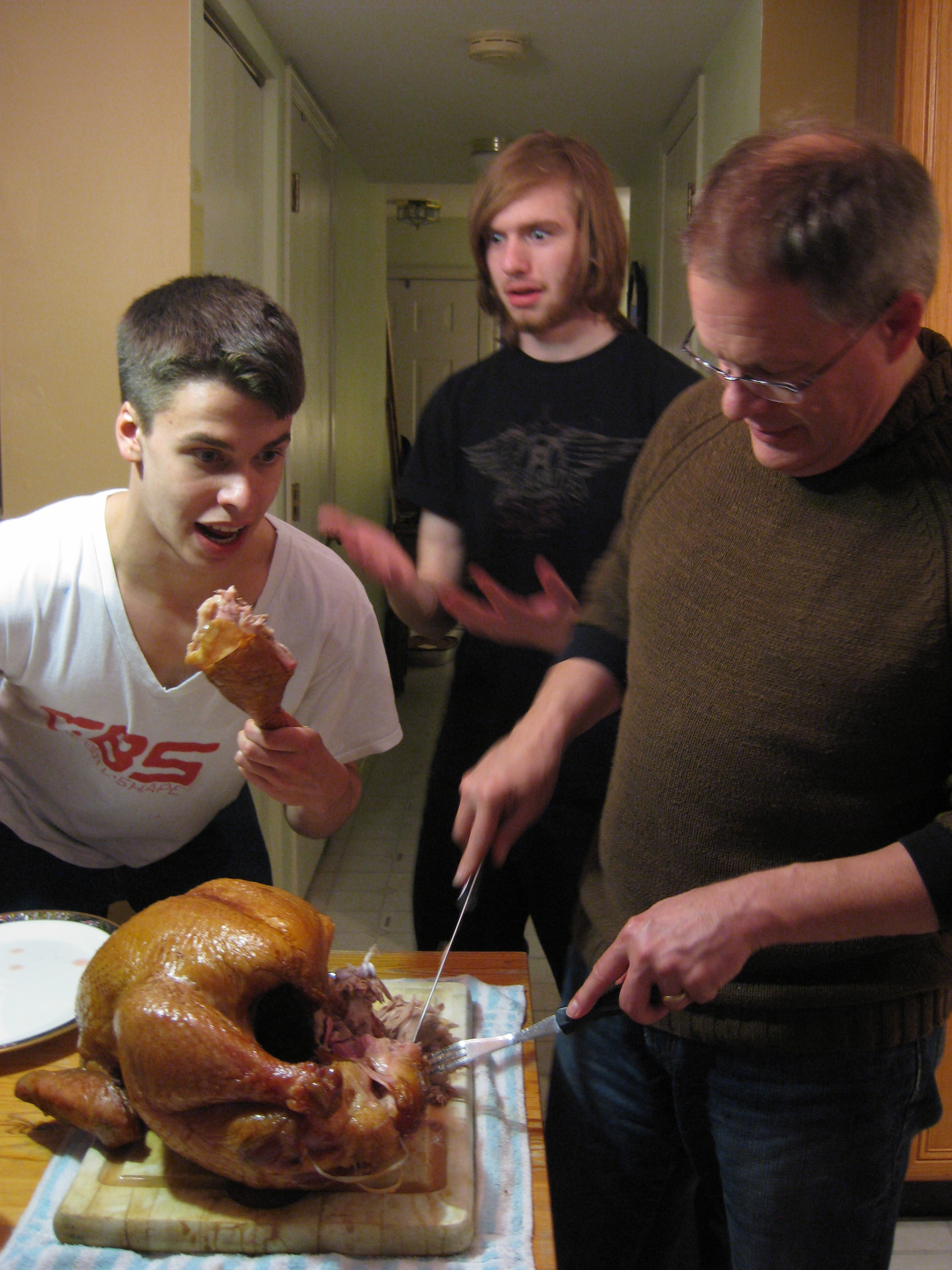
    Every year, family and friends gather at my house for Thanksgiving. I’ve done it so many years that it no longer causes any anxiety. In fact, it’s Monday and I haven’t even bought the turkey yet.

    I’ve had anywhere from ten to more than twenty people at my tables, because it usually takes more than one. Not too long ago, I had planned for twenty-two guests. Thanksgiving morning, my niece called begging to bring one more person, an exchange student from Sweden, to the feast.

    Much as I love the baking, cooking and decorating for Thanksgiving, I love the gathering. Of course, the exchange student came because, for me, it’s the welcoming that matters when we’re giving thanks.