Category: Mommy blogger

  • Two Steaks, Twenty Dollars and My Mind

    When I moved to Naperville, I hated not knowing where I was. Oh, I knew where my house was in relation to the major highways, but I didn’t know the city the way I had known Oak Park. To be fair, Oak Park covers 4.7 square miles directly to the west of Chicago. Like Chicago, its streets are straight, running north/south or east/west. Naperville covers 35.5 square miles. There are a handful of straight streets, mostly in the older, downtown area. In the newer sections, and there are lots of newer sections, the streets have been designed to curve and wind gently through the rolling countryside, I suppose to make up for the fact that all of our houses look exactly alike. Actually, there isn’t much countryside left out here and any rolling is manmade.

    Naperville seems to specialize in streets that take you right back where you started. In my own neighborhood, there are numerous “courts,” or cul de sacs. You enter and exit from the same point. That’s actually pretty straightforward. More confusing are the “circles,” which are streets that have two points of origin. My husband, who routinely blew off our street when we lived in Oak Park, would appreciate it if we lived on a circle. Then he’d have two chances to get driving home right.

    For a while after we moved, knowing how to get Target was sufficient. Soon, though, I wanted more mastery over my geography. With no lake to serve as a point of reference, Naperville proved a geographical nightmare.  So, I would get lost. On purpose. What with the circles, cul de sacs, unincorporated areas and streets that change names mid-street, it’s pretty darned easy to get lost in Naperville. Obviously, I always found my way back home.

    I haven’t always been lucky in loss. Frankly, I’m a world-champion loser. I am resisting the urge to write, “Just ask my kids,” but, clearly, I am losing that battle with myself. See? I really am a loser.

    I have lost all kinds of things. Recently, I lost two steaks. They were big fat rib-eyes, grass-fed, that I snatched on sale at Whole Foods. In the pantheon of things that will stop your heart cold, rib-eyes are up there with an air embolism and Tori Spelling without makeup. I make myself believe that, if I buy them at Whole Foods, the good I do the Earth balances the evil I do to my body in a sort of personal health “cap and trade” program.

    I got the steaks home and then they disappeared. For days, I rummaged through the refrigerator and the freezer hunting down the steaks. Eventually, I gave up, assuming I’d find the steaks the same way I found a pound of hamburger I lost when my son was a baby—by smell. But, the house didn’t start smelling like the stockyards on a summer afternoon so soon enough, I forgot the steaks.

    I don’t just lose meat; I lose money. Now, I’m not talking about making bad investments. I don’t need to invest one cent to lose money. I lose money just by letting it out of my hands. The problem is that I don’t let the money out of my hands in a controlled, habitual manner. If I were to take money that is given to me and immediately place it in my wallet, I would not lose money. But I don’t, thinking that if I do, I will then spend the money. So, I put money all over the place. I put it in my back jeans pocket. I put it in my jacket pocket. I put it in the cupboard with the coffee cups. I put it on top of my clothes drawers in the closet. I put it in any of the three or four pockets inside my purse. I put it on counters, in drawers, in cups, in nooks and in crannies

    I love winter, but not because the snow is pretty and covers up all the ugly gray drabness that is Chicago after autumn. I love winter because I find money in just about every pocket of every coat I own. The first few weeks of winter are like winning the lottery. Every day, I find anywhere from one to ten dollars waiting to make my day. So far, most of the money I’ve lost has come back in due time. Still, there is a twenty-dollar bill floating around the house somewhere.

    I lose my keys, but everyone loses their keys. I lose whatever book I’m currently reading at least two times per day. I’ve found them all sorts of places, like in the gazebo, under the dining room table, in the car. Once, I found a paperback on a shelf under the sink in the bathroom.

    Something I’ve never lost, though, is my mind. I was diagnosed with bipolar disorder sometime after I had my son. I’ve been treated for depression. I’ve been treated for dysthymia. Never, in all the years I’ve been treated for my myriad of mental maladies, have I misplaced my mind. Frankly, there were times I wished I could. I was naturally curious then when I discovered iCarly, the kids’ show on Nickelodeon, would be airing an episode titled “iLost My Mind.”

    I was warned that this episode would present a terrible picture of mental illness and institutions that treat it. Mental health support groups implored parents to boycott the show. Of course, my daughter wanted to watch it. So we did what we’ve always done when my kids wanted to watch something I was pretty sure was crap. We watched it together.

    “iLost My Mind” is crap. I did not say, “I told you so.” We did talk about what was funny and what was not. Not funny: dirty walls with signs on them saying things like “Don’t eat the puzzle pieces” and “Friends don’t kill friends.” Funny: a male character dressed up as one of the other character’s moms. My daughter admitted that she understood that delusional people don’t act the way the characters in the show did but she thought one of them was funny anyway. And, we talked about how people with mental illnesses are a lot more like her mom than the characters in the show.

    I found the steaks. They were delicious. I have no idea where the $20 went. Perhaps my son knows. And my mind? Firmly and permanently ensconced in my skull.

    © Copyright 2011 by Janice Lindegard. All rights reserved.

  • Dead Squirrels and Anger Issues

    I was making my daily “survey the acreage” walk around my home last Friday. First morning cup of tea in hand, I walk a circuit either from front door to back or vice versa. Along the way, I make note of things that need attention, but since I have nothing to make the note on, I usually don’t remember the thing that needed noting until I’ve noted it several times.

    This particular morning, I hadn’t even left the house and I already knew something wasn’t right. I looked out my front door and saw a grey lump in the middle of the sidewalk. “Hm,” I hm’d, “someone left one of Pogo’s stuffed animals outside.”

    Pogo, our dog, once brought me a present of a dead baby rabbit. Since then, he’s enjoyed a series of stuffed faux wildlife. He delights in grabbing the critter in his teeth, then whipping his head back and forth until the poor thing pops its stitching. More than once I’ve come into the family room to find a limp, drool-soaked faux hide lying in the midst of a mountain of fluffy white stuffing.

    A closer inspection revealed there was nothing faux about the wildlife on the sidewalk. Doing my best “Ducky,” I deduced that the squirrel, due to the relatively intact state of the body and scant amount of blood, had literally dropped dead out of the parkway tree onto the sidewalk. Removal, I further deduced, was a job for Animal Control.

    Animal Control informed me that wildlife removal was my responsibility. Period. Oh, they gave me the helpful suggestion of using doubled grocery bags, garden gloves and a shovel to secure the dead squirrel and then said I could just drop it in with my normal trash. I balked at this.

    When my dog, which I own, dropped a dead bunny, which he killed, onto our deck, which is in our back yard, I put the dead bunny in my trash. It stank more than stink can stink by the time the trash was collected some days later. Surely, removing a wild squirrel that fell from a publicly maintained tree onto a publicly owned sidewalk is the responsibility of the public. Nope.

    By this time, the cul de sac was filling with children playing in various vehicles. One was being pedaled as quickly as its toddler driver’s legs could pedal it straight toward the dead squirrel in the middle of the sidewalk. I warned the parents, saying I’d get to the squirrel as soon as my skin stopped crawling. Then, a miracle occurred. The dad offered to dispose of the squirrel. I looked at him as if he were insane. He said, “No, really, not a problem!” He was sincere; his eyes gleamed. I looked to his wife. She said, “Oh, he gets rid of dead animals all the time!” At this point, I figured it was not just convenient to have him remove the animal, but indeed it might be unwise to deprive him of the pleasure . . . of helping a neighbor.

    Squirrel dispatched and it being my daughter’s birthday, I started cleaning up the house in preparation for family festivities. At some point, the phone rang. There was something else going on in my life at the time that required me to lower my defenses just a bit. Otherwise, I never would have done what I did. I answered the phone, even though the caller ID said, “Private Caller.”

    Private Caller said he was looking for Alan Zachary. I asked Private Caller for his name. He said he was looking for Alan Zachary, that he had a package for him. I asked him for his name. He asked me, “Are you, like, Mr. Zachary’s wife or something?” I said that I was not like Mr. Zachary’s wife, that I was indeed Mr. Zachary’s wife. Finally, he told me he was John Lynch, that he was with the IRS and he had a package to deliver to my husband. So I said, “Well, deliver it.”

    “Yes, m’am,” he said, “this is what I am trying to do.” John Lynch had a foreign accent, so it came out more like “thees ees what I am trying to doooo.”

    “Fine,” I said, “deliver the package.”

    “M’am,” he said, “Thees ees a cashier’s check. We are trying to deleever eet. You need the code.” Code? I thought. Since when does the IRS use codes? Fear, yes. Codes? Foreign accents? Refusal to identify self?

    “Who are you?” I asked. At this point, I figured he knew that I knew that he was a scam artist, but this was a day that started with a dead squirrel, so I played through.

    “M’am! I am telling you! I am John Leench. I am trying to deleever a package to your husband.”

    “And I’m telling you to deliver the freaking package,” I said. I may have used a different “F” word.

    “M’am,” John Lynch said, “you have anger eessues.”

    I started to tell Mr. Lynch that he had some nerve calling me to scam me and then accusing me of having anger issues, but he kept interrupting me to tell me that I was behaving like a child and that I needed anger management classes. So I hung up.

    The phone rang again. I was in another room. I let it go to voicemail. Then it rang again. Maybe it was the dead squirrel, maybe it was the other pressures in my life, I picked up the phone. It was John Lynch.

    “Hello, m’am,” he said. “You must stop acting like a child. I am trying to deliver the package to Mr. Alan Zachary.”

    I decided to have a little fun with Mr. Lynch. I did my “I am the most reasonable woman in the world” routine and asked him to repeat everything he had already told me. I promised to speak with my husband and get back to him. John Lynch breathed an audible sigh of relief and told me that he worked for the Treasury Department. He gave me a 202 area code number where I could reach him. “Oh,” I said, “I thought you were with the IRS.”

    “Yes, M’am. The IRS and the Treasury.”

    “And what did you say your title was?”

    Silence. I heard John confer with someone.

    “I am the manager, m’am.”

    “And what department do you manage, Mr. Lynch?”

    “The Treasury department.”

    “The whole deparment?”

    “Yes, m’am.”

    “Where are you, Mr. Lynch?”

    “At the Treasury department.”

    “No, where is your office? Where are you right now?”

    John put his hand over the receiver for a moment, then came back on the line.

    “I am in Flareeda,” he said, with the emphasis on the “ree”.

    “I’m afraid I’ve never heard of that. Where are you?” I asked.

    “Flareeda, m’am. Flareeda. It’s in the US.”

    “Oh, you mean Florida,” I said.

    As I signed off with Mr. Lynch, he told me to be sure to get some anger management classes. I told him something he could do to himself, then phoned the Treasury Department Fraud hotline.

    My day did not improve after hanging up with Mr. Lynch. My daughter accused me of treating her birthday as if it were any other day. I got a nosebleed as I stepped out of the shower. I sneezed my lunch all over my hand. I had an upsetting conversation with a friend. My computer froze. I realized I had neglected to invite my father to the family birthday dinner that evening.

    Still, I made it to the end of the day. My daughter had a lovely dinner at her favorite Chinese restaurant with (most) of my family. I unwound with a cup of tea and a slice of bright blue birthday cake.

    After everyone had gone, I checked voicemail.

    “M’am,” John Lynch’s voice said, “you need anger management classes. You have anger eesues.”

    Maybe I do, I thought. But I got through a day that included a dead squirrel, a delusional Nigerian scam artist, a nosebleed, a pouting Birthday Princess and a hand covered with lunch sneeze. In the end, I was surrounded by family and there was a smile on the Princess’ face. Not a bad end to a pretty bad day.

  • Zen In An Ear Of Corn

    When I was a child, I believed that one was either Catholic and Republican or went to hell. When I grew up, I chose hell. Actually, I chose to become a Buddhist and a Democrat. Same difference.

    Though I have yet to discover if I will indeed go to hell when I die, my choices led to at least one hellacious family dinner. I had come to visit my parents wearing a “Mondale-Ferraro” button on my coat lapel. During dinner, the discussion turned to politics. I swear I did not start it! My mother, bless her heart, was Southern. She taught me right. I do not bring up politics at the dinner table, but I sure went there when talk turned to taxes and prayer in schools. The conversation ended with Dad walking out and Mom telling me, “I just wish you prayed, honey.” My husband, on hearing this story, said that Mondale and Ferraro were a waste of a family feud.

    Apparently, my Buddhism is less troublesome than my politics. Once I told Mom that Buddhists do, indeed, pray, she was cool.

    I think my Buddhism goes down easier because Buddhism is easier on the non-practitioner than it is on the practitioner. What’s to worry about from a peaced-out, meditating, non-violent vegetarian? Getting to the peaced-out, meditating, non-violent vegetarian state is much harder.

    Before I had children, the meditating and non-violence were easier. The vegetarianism? Not so much. My metabolism seems to require regular doses of high quality protein, otherwise known as “meat.” My children believe that eating meat makes me a bad Buddhist. But I read somewhere, and I am not making this up, that some good Buddhists eat meat. It’s one of those “angels dancing on the head of a pin” arguments. You ponder and obsess about whether or not eating meat makes you a bad Buddhist until your obsession with determining if you are a bad Buddhist actually makes you a bad Buddhist. Better to shut up and eat your meat.

    While the vegetarianism was always a challenge, meditation and non-violence were a breeze. You can meditate for hours when you don’t have any distractions. In fact, there are Zen teachers who create distractions, like whacking their students on the back with a stick.

    Now that I have children, I have no need for a Zen master to whack me on the back with a stick. If I’m busy folding laundry or cleaning the kitchen, my children can be completely occupied with other things, like video games and Selena Gomez movies, things that I would not be able to pull them away from if I stood in front of them naked screaming, “We’re going to Disney World!” But if I settle into a lotus position—really more of a pansy position now that I am over 50—they will be on me like ducks on a June bug.

    No, I don’t need a Zen master anymore. My children are my Zen masters. I discovered this when my son was three. We had been out doing errands. He was being a great little errand runner. I had gotten everything done that was on the list. I was ready to get us both home for a snack and a nap. He was not. He was so not that he executed the Plank Maneuver when I tried to buckle him into his car seat. Those of you who’ve had children can skip the next paragraph; you know what the Plank Maneuver is.

    Children learn, somewhere around the age of two, that they have the ability to solidify every muscle, tendon and ligament in their tiny bodies and that they can do this at will. In the Plank Maneuver, the child solidifies all of the above mentioned body parts all at once, turning his body into a human two-by-four.

    It is hard enough buckling a three-year-old into a car seat. Buckling a plank is impossible. The belt is not long enough to accommodate the plank and the plank is not about to bend. Still, I struggled mightily with the plank. I wanted nothing more than to get home and I was going to get home if I had to bend that kid in half, breaking every bone in his stubborn little body to do it. Then, I realized I was thinking of breaking every bone in my child’s body . . . not literally, of course. So, I stopped fighting. I accepted that he wanted to climb around the back seat of the car. Because he also wanted nothing to do with me—I think he caught the “nice mommy has left the building” vibe—I decided to call my mother. I had a lovely conversation, uninterrupted. My son explored the car to his content, got in his seat and let me buckle him. We went home and had a nap.

    My children aren’t the only Zen masters in my life now. Without much time for meditation, I’m working on turning running into a meditative practice. Unfortunately, cyclists on the trail I use have a tendency to zoom up behind me unannounced, scaring the peace right out of me. I curse them roundly in my head, thereby further ruining my Zen state. I decided to switch tactics. Instead of cursing the cursed cyclists, I would try blessing them, using the words, “May you live in safety and be happy.” At first, the blessing tended to come out as “May you live in safety and be happy, jerk.” This did not achieve the desired state of calm. I progressed to wishing them safety and happiness through gritted teeth, minus the epithet. I’m up to hoping they live in safety because then I’ll be safe. Room to grow.

    I was at a family dinner recently and started a discussion of Zen masters. I related the plank incident and asked the others who their Zen masters were. My brother-in-law said, “This corn.” We laughed. I realize, now, that he was the Zen master at the table. Being present, fully present, in the moment is what Buddhism is all about. How much more present can you be than thoroughly enjoying an ear of summer sweet corn?

    May you live in safety and be happy.

    © 2011 by Janice Lindegard. All rights reserved.

  • What I Learned On My Summer Vacation

    Summer vacation brings to mind long car trips, my little brother comfortably wedged between Mom and Dad in the front seat and my sister and I in the back. My sister refuses to believe that she would terrorize me into sitting in the wheel well so that she could lie down on the back seat. I refuse to believe that I would willingly sit in the wheel well, so we are at a standstill over this issue.

    It’s a cliché, and I do so hate to be a cliché, but my flight to Boston recently was only marginally more comfortable than traveling in a wheel well. I was lucky enough to have a travel companion who didn’t snore, smell or attempt to annex my seat. That this companion was also my son made the trip that much more bearable. In fact, I was in a very good mood as we winged our way to Beantown. I was on a mission: visit my son’s dream college so that he could see for himself that college is not a mythical place that swallows his cousins for years at a time, spitting them out intermittently to attend important family events. With any luck, I thought, he might also discover that he wants to attend college and needs to work hard now even though he won’t hit freshman year until 2014.

    I learned many things over the course of two and a half days, most of them surprising.

    Surprise number one: my son will eat vegan food. While I don’t necessarily believe in fate, I do welcome a serendipitous unfolding of events. Just days before son and I were to leave for Boston, a friend invited us to his daughter’s Senior Recital. We have no money and, therefore no lives, so we were happy to accept. Actually, we would have been happy to accept in any circumstance. The young singer in question is a truly lovely and talented girl who once babysat our daughter.

    While we waited for the recital to begin, we chatted with others we know. In that wonderful way the world has of dropping plums in my lap…ok, that’s just crap. I don’t usually get plums dropped in my lap. I’m the one watching other people get plums dropped in their laps while I stand there saying, “Where’s my plum?” So, when life does manage to drop me a plum, I snatch that puppy up. Here’s the plum. Through the pre-recital chat, I learned that we know a young man who graduated from Berklee College of Music (son’s dream college) and—here’s the plumiest part—still lives in Boston.

    Proactive mom that I am, I got in touch with the Berklee alum. We’ll call him Mark. Mark said he’d be happy to host my son and me at his place for dinner. Actually, he had no idea who I was at first but I am either very persuasive or he eventually remembered our connection.

    We arrived at Mark’s place, a huge old Victorian mansion in the Roxbury neighborhood, which houses twelve people united in a desire to live sustainably, spiritually and affordably. They call it a co-op. Back in my time, we called it a commune. While I didn’t smell any patchouli, my son declared everyone “hippies.” We talked with Mark while the other hippies, I mean, residents prepared dinner. My son was rapt in that sort of nervously nonchalant way teen boys have of hiding the fact that they are so excited they would squeal if they were girls.

    Then dinner was served. There was curried couscous with cashews and peas. There were homemade veggie burgers bursting with lentils. There were beet greens sautéed then sauced with balsamic vinegar. There was a platter of thick, juicy grilled tofu squares. My son ate it all, politely, and thanked the cooks when we left.

    Surprise number two: it takes a whole lot of Coldstone Ice Cream to remove the taste of vegan from a 15-year-old’s mouth.

    Surprise number three: my son is not a vampire; he does not spontaneously combust when exposed to sunlight. Frankly, I was astounded that someone who spends eighty percent of his day sitting on his…chair playing video games could make it from the hotel room to the curb without complaining. In fact, he walked ten miles without complaining. Now, it probably helps that he didn’t know he’d walked ten miles until we sat down that night to figure it out.

    Surprise number four: what they’ve done with Faneuil Hall and the surrounding area is criminal. My son and I both particularly wanted to see Faneuil Hall, mostly because we think it’s fun to call it Feng Shui Hall, but that’s a long story. The website proclaims Faneuil Hall Marketplace a true Boston experience. I proclaim it a cross between Navy Pier, the Mall of America and every food court fast food emporium in America. I’m not buying the true Boston experience thing ‘cause I’m pretty sure Ann Taylor was not one of the founding fathers. I’m also thinking Betsy Ross didn’t wear Victoria’s Secret bras and Washington’s troops were not shod by Orvis.

    Surprise number five: there is a Texas cheerleader mom hiding in my soul. We did the official Berklee tour with a number of other families and their beautiful, talented children. Two of the kids came all the way over from Sweden. There was a singer from Paris, a pianist from Brazil and a bunch of other kids from places I can only vaguely remember, including one really strange and hostile young woman. And there was my son.

    As we toured the school, I kept an eye on my son and his reactions, hoping for some indication that mission was being accomplished. Nothing. Nothing, that is, until we came to the recording studios. I know the fire was lit there because he did something I’ve never seen him do. He asked a total stranger a question. Actually, he sought out the total stranger and asked him a question.

    In that instant, a nearly suffocating desire to protect my child took me over. I looked at the other children and saw talented young musicians. I looked at my son and saw my baby. Yes, he’s a talented young musician, but he’s also sensitive and vulnerable and “What,” I thought, “would it do to him if he wasn’t good enough to get in?” I closed my eyes and fought the urge to hold him close, as if he’d even allow it.

    So, Boston visited. Son inspired. Mission accomplished. And if I start letting go of my baby now, maybe I’ll be ready for him to fly off to Boston on his own in three years.

    ©Copyright 2011 by Janice Lindegard. All rights reserved.

  • Our Rationing Program

    I’m flying to Boston tomorrow with my son. This presents me with a myriad of problems, such as how I will keep a 15-year-old boy fed over the course of two and a half days when said 15-year-old eats only meat and his mother likes to get her veggies and whole grain. Once we land, we’re planning on taking public transportation. I figure we’re going for the total college experience, so he should ride a few buses and do a subway or two. (Boston has a subway, right?) Figuring out what to take and where to connect ought to be lots of fun with a perimenopausal woman, a surly young man and two over-packed suitcases.

    My biggest problem with going to Boston isn’t really going to Boston. No, my problem is this: what do I do if I have to go while I’m on my way to Boston? I hate airplane bathrooms. It’s not just that they are small. It’s not just that they smell. Small isn’t much of a problem for me. And smell? Well, I’ve got a dog that doesn’t know the difference between grass and carpet.

    I can deal with small; I can deal with smell. I cannot deal with my fear that, when I flush the toilet, I will be sucked out of the airplane. There. I said it. I’m afraid I’ll be jettisoned into the wild blue yonder. I am completely aware that this is not only irrational, but also impossible. Still, every time I use the restroom mid-flight, I mentally gauge how wide the toilet is versus my shoulders.

    Everyone in my family laughed at me when I admitted my fear. I did not laugh nearly as loud and hard when they admitted their fears to me, but I’m far more gracious than I ever get credit for. More mature, too.

    My husband is inordinately afraid of knives. I wouldn’t call his fear irrational because knives can do some pretty serious damage. My mother dropped one blade-down on her foot once. (You flinched, didn’t you?) Knives won’t, however, spontaneously fling themselves across the room and attack you without cause. This is an exaggeration of my husband’s fear, of course, but only a slight one. He’s pretty happy with our new dishwasher because the silverware basket requires knives to be placed blade down. He rests easier because now unloading the dishwasher is a little bit safer for our son. I always put the knives blade-down in the old dishwasher, but in the new one you have to, so that makes it better according to my husband.

    My son is afraid of spiders. I find this “bugs and spiders are scary and ooky” thing really annoying. I know this makes me less of a feminist, but I especially have no patience with it in girls. Wait! Brainstorm! I just figured out that my attitude toward spider-frightened girls is very feminist. Girls are strong! Girls can do anything! Of course, you can deal with bugs and spiders! Get on with it, Missy! Grab your Exterminator Barbie and let’s go! Boys, on the other hand, need to be taught to embrace their fears, their vulnerability. Damn! Don’t tell my son I just gave him an out on capturing spiders. He’s actually pretty cute when he thinks he has to convince me to get rid of them.

    Lots of people are afraid of spiders, so that doesn’t really count as irrational. My son did have an irrational fear when we first moved to Naperville. He was convinced that a murderer was going to swing into his room at night and kill him in his bed.

    “How will he swing into your room, son?” I asked. “There are no trees near your window.”

    “He’ll use a grappling hook,” my son said, in equal doses of fear and sincerity. Ah, the seeds we sowed when we introduced our son to Batman.

    Every night, fear of the Grappling Hook Murderer brought our son to our bed. Every night I assured our son that no one was going to swing into his room via a grappling hook. Every night, the scene replayed. I almost asked him once, “Why on earth would anyone go to all the trouble of getting a grappling hook and a rope and driving out to Naperville to kill a nine-year-old boy? Where do you even get a grappling hook?” Wisely, I think, I did not ask. But I did have what I thought was a stroke of genius. Instead of driving past the police station on the way to the library, I stopped in one day. I marched my little brood up to the front desk and said, “My son is afraid that someone will swing into his room using a grappling hook and will then murder him.”

    The officer behind the desk looked down at my son and very calmly said, “Oh, I wouldn’t worry about that. We’ve never had anyone killed by someone using a grappling hook. No, son, you’re more likely to be hurt by someone you live with.”

    Our son stopped coming into our room after that.

    My daughter doesn’t really understand what an irrational fear is at this point. To her, every fear she has is rational. I’ve noticed she’s a little too dramatic when she stubs a toe or gets a bump on her head, but she seems to know what requires a hospital trip and what doesn’t. She’s afraid of her brother, too, but I would be if I were her. He has taken sibling relations beyond rivalry to full-out war. Even buying packs of gum requires negotiation. We are making incremental progress. He now says, “I don’t care” to everything she says rather than “No one cares!”

    There is one fear my daughter will own up to that gives me hope she’ll be as neurotic as the rest of her family. “I used to be afraid of Santa until I found out it’s you,” she told me. “Why is that?” I asked. “Because the Santa in the mall is creepy,” she said.

    I’ve seen that Santa. He is creepy. Nothing irrational about that fear.

  • Say What?

    I read once that for every word a man says, a woman says three. Elements of my life bear this out. At our dinner table, for instance, I have frequently thought that if I did not start a conversation, no conversation would get started. I tried testing my theory. We ate in complete silence while I waited for someone other than me to speak. Unfortunately, I’ll never know if any of my family members can start a conversation. After an interminable seeming two minutes, I jumped into the verbal void with, “Wow. You all seem very quiet tonight.”

    Quiet does not ordinarily describe my family. Usually we’re a chatty bunch and, in fact, we’ve even developed our own argot, “argot” being a word I just looked up that means we have a language that we’ve developed over time that is just ours and that might be incomprehensible to others. Isn’t the Internet wonderful?

    A large part of our argot is derived from movies, old ones in particular. For instance, I have been known to anger my husband on occasion. He, being particularly conflict avoidant, will not say, “I am really angry with you.” Instead, he will brood; leaving me to figure out what it was I said or did that has turned him into The Incredible Sulk. Frequently, I’ll know exactly what it was I said or did. Not being the kind of person who can live in I’m-Not-Talking-To-You Land for any length of time, I’ll rather sheepishly say, “You do despise me, don’t you, Rick?” Referencing Casablanca, I acknowledge my own despicable behavior and his understandable reaction.

    We’ve developed code for distressing situations of a different sort as well. Say something bad happens. It could be anything, from news of our son’s grades to needing new tires on the car. Rather than calling and saying, “Wow, I’ve got really bad news…our son is failing all of his classes except PE,” I’ll call and say, “Houston. We have a problem.”

    My son has a few of his own sayings, most of them obscene. He is most known, however, for saying, “What do we have to eat?” I respond, “The same things we had two hours ago when you asked what we have to eat.” Second only to “What do we have to eat?” is “I’m bored” to which I always respond, “You could read a book.” He then says, “I’m already bored, Mom.” Obviously, my son does not have the same fondness for reading that I do. Why then does it bother him so every time I finish a book? In fact, he impersonates me by pretending to speed read a book then saying, “Ok, done!” and flinging the book aside. Now, because I am so mature, whenever I finish reading a book, I bring it to his room, set it on his nightstand and say, “Ok, done!”

    When my son was little, he watched Thomas The Tank Engine, another source for our family lexicon. Thomas, as you may know, is a rather small but dependable little engine. In short, very useful. His co-trains (what DO you call the animated trains that work with you?) include some much larger and far more egocentric engines. Chief among these is Gordon, a self-described “very important engine.” Gordon chuffs around all puffed up with his own grandiosity. Though our son’s Thomas trappings are safely stored in the basement, we haven’t retired the language. Calling someone a “very important engine” is so much more genteel than calling them an insufferable egomaniac.

    Sometimes, I am at a loss for words. Hard to imagine, I know. More and more though, I will be about to say something and completely forget the word that was going to come out of my mouth next. Generally, the word is a noun and I can picture the object attached to that noun, I just can’t get the word out of my mouth in a reasonable amount of time. To avoid looking like a blithering idiot and prevent others from finishing my sentence (they never do it right), I have taken to inventing words. So, for instance, I would like my son to hand me a mixing bowl, but I cannot remember the word for mixing bowl. I will, instead, say, “Hand me the . . . flarblaster.” What does it say about him that he knows what I am referring to? Sometimes, when this happens, I am relieved I don’t have a regular classroom to teach. I imagine the parent-teacher conferences. “Well, Mrs. Parent, I’m concerned that Timmy is not doing well with his . . . geflerbenmeisten.”

    My daughter is becoming a source of amusing entries in our family lexicon. Not too long ago, she and I were watching some terrible little girl movie like “My Little Pony and The Crystal Princess” in which the Little Pony screws up yet again, doing exactly what she was not supposed to do. Despite her blatant disregard for the rules, the Little Pony is forgiven by the other ponies and allowed to become the Crystal Princess, thereby sending my daughter the message that it’s ok to ignore the rules and screw up as much as you like because all the other ponies will forgive you no matter what you do. But I digress. So, my daughter and I were watching “My Little Screw-up,” when I detected a particular odor. “Daughter,” I said, “did you toot?” She immediately said, “No, mama, that’s my natural smell.”

    As amusing as my daughter is becoming, there is something I hope to never hear from her lips again. She has taken to playing hand-clapping games. I do not remember playing such games as a child, but then my fondest childhood memories are of sitting in the cool of the family room reading the encyclopedia while the other children frolicked in the summer sun.  The words to my daughter’s favorite hand-clapping game are: “Double, double this. Double, double that. Double this. Double that. Double, double this that.” They are more mind invading than that stupid “What’s my name” song by Rihanna. Just typing the words has put them on endless replay in my brain. But, let me ask you a question. Will you forgive me if they get stuck in your brain, too?

  • Bad–I mean–Dad Jokes

    Yesterday, my husband and daughter were playing Monopoly while I was preparing the Father’s Day dinner. I make dinner every night, so it’s not a particularly stimulating event for me. I listened in on their conversation while I cooked the hamburgers, my husband’s idea of gourmet food.

    When my husband landed on Reading Railroad, my daughter, the banker, asked if he wanted to buy it. It was early in the game and he was collecting all the properties he could so he said, “Sure!” My daughter took his money. As she handed over the little railroad card, my husband sang, “I’ll be reading on the railroad,” obviously to the tune of “I’ve been working on the railroad.” I groaned.

    A few minutes later, my husband landed on the B&O Railroad, which he bought. As my daughter handed it over, he sang, “I’ll be smelly on the railroad.” This time I looked at him over my glasses with my “Really? You just said that?” face. He just grinned the goofy grin he always grins when he commits a crime of comedy.

    I don’t think my husband was always humor-challenged. I can’t recall any particular funny thing he said or did, but I have a vague sense that he was once witty. No longer. Now, he is the Baron of the Bad Joke. In fact, at least at home, groan-inducing commentary has become his signature comedic style.

    I do know exactly when my husband went from humorous to humor-less. The moment our son was laid in his arms, my husband’s funny bone broke. He started his slide into a life of comic crime by supplying lyrics to well-known arias related to whatever dad duty he was performing. Most notable of his alternative opera was the diaper-changing aria, sung to the tune of that “Figaro, Figaro, Figaro, Figaro” song. The words described the contents of said diaper, like this: “Poop-a-la, peep-a-la, poop-a-la, peep-a-la,” repeated until the task was complete.

    My husband is not the only man to be so affected by fatherhood. In fact, I have a theory that has been born out again and again. I am convinced that no man becomes a parent without also becoming a purveyor of the dreaded Dad Joke.

    Recently, my son’s guitar teacher became a dad. Before his transformation, he was a pretty cool guy. Heck, he’s a guitar teacher. Of course he was cool. Evidence of his turn to the Dad side was revealed at the first lesson following birth of his daughter. I think my son had been working on a difficult passage the week prior. On seeing his teacher, he jokingly said, “I hate you!” His teacher’s response? “Why do you dislike female sheep?” Groan if you will. It’s completely warranted.

    Though my siblings and I long ago moved out of his house, my own dad is still pouring on the crummy quips. I’ve written before about his “I know God’s name” joke. For those of you who don’t recall, God’s name is Harold, as in “Harold be thy name.”

    I let my dad’s Dad jokes slide, but my husband is ridiculed mercilessly, especially by me and my son. In fact, we are much more amused by our insistence that Dad has no sense of humor than we ever are by his attempts at humor. See for yourself if you don’t agree. Recently, I purchased TurboCAD to assist me in producing landscape designs. I left the box on the dining room table until I had time to install it on my computer. Now, of course, I know I should not have left the box on the dining room table where it didn’t belong but there you are. My husband, seeing the box, said, “TurboCAD? Is that a man who is really bad to women?”  Or, try this. I was slicing up some cantaloupe. My husband walked by singing, “Come to me, my melon-choly baby.” Or, this. I made some pastries. I asked my daughter, “Would you like a turnover?” She said she wouldn’t. My husband said, “Well, how about a new leaf?”

    “Dad, you’re not funny,” has become the family joke. My son insists that my husband is funny outside of our home, though. The two of them visited my sister-in-law not too long ago. On their return, my son reported that his father had actually had his sister, her daughter and my son in stitches with some shtick involving our cat and his many misdeeds. My husband repeated the performance for me. I didn’t think it was funny. My son didn’t think it was funny. My daughter didn’t think it was funny. Even my husband admitted it wasn’t funny. I guess you had to be there.

    I’m pretty sure what’s happening at our house is that the kids are outgrowing Dad jokes faster than my husband can give them up. Saying, “Didn’t you have enough s’mores?” after a child has repeatedly asked for some more of something is a gut-buster when you’re six years old. At fifteen, such a comment is most likely to send the kid scrambling for Mom’s blog fodder note pad.

    Dad jokes are definitely intended for a general audience. My dad soothed more than one tiny soul with a well-timed ridiculous comment. I have very fond memories of being scolded. Actually, my fond memories are mostly of what happened after the scolding. I would run to my room screaming how much I hated my parents and how unfair they were for scolding me. I slammed and locked the door, intent on never again looking upon the face of anyone vaguely related to either of my parents, excepting me, of course. After a while, there would be a soft knock at my door. My dad would call my name. I would ignore him. He would call my name again. I would ignore him again. He’d ask me to open the door. I would ignore him yet again. Then, he’d start with the jokes. My resolve would slowly dissolve. Eventually, I would open the door, my dad would pick me up and I’d decide he wasn’t so bad after all.

    My son is fifteen and he is probably the funniest person I know. He can have his father and I laughing so hard it hurts. I would repeat some of his more hilarious humor, but most of it is incredibly tasteless. In fact, some of it would make Bob Saget blush. There is some evidence, though, that he, too, will fall into the Dad joke pit when his time has come. Recently, I made a joke that missed the mark. My son started singing, “FAIL-ga-ro! Fail-ga-ro! Fail-ga-ro! Fail-ga-ro!”

    © Copyright 2011 by Janice Lindegard. All rights reserved.
  • Adoption–and Stupidity–are Forever

    When my daughter was in kindergarten, her teacher developed a semester-long unit of study on Antarctica. Being the helpful soul that I am, I suggested the class sponsor a penguin. They’re cute, they live in Antarctica and they are endangered. The teacher agreed and the class collected money for the sponsorship. They sent the money off to whichever  “Save Antarctica” organization it was that was collecting children’s pennies for penguins.

    Some time later, my daughter asked me, “ Mommy, when will we get the penguin?”

    “What penguin,” I asked, having forgotten the penny collection.

    “The penguin!” she said, vehemently, apparently believing that additional verbal force might force my brain into remembering.

    “I’m sorry, honey,” I said, “I just don’t know what penguin you’re talking about.”

    “The one we adopted, Mommy! When do we get to bring him home?”

    My daughter wasn’t trying to be cute. The penguin-saving organization called their sponsorship an “Adopt a Penguin” program. In our house, when you adopt something, you take it home and then you care for it and love it forever. My daughter was thinking it was about time we flew down to Antarctica and brought that penguin home, just as we’d flown to China to bring her home. I’m relieved that my daughter’s school didn’t adopt a highway. I don’t think it would fit in our living room.

    My daughter has been home for nearly eight years now and one thing I’ve learned in all that time is that people can be pretty darn stupid when it comes to adoption. Actually, people can be pretty darn stupid about a lot of things, but adoption really seems to bring out the insensitive jerk in a whole lot of people.

    We may get more than our share of stupid adoption comments because my daughter is Asian; my husband, my son and I aren’t. If you have eyes that work, it’s pretty evident that our daughter was adopted. My son is particularly annoyed by people who, on seeing him with his sister, ask if she was adopted. “No,” he likes to say, “my parents converted to Chinese after I was born.” I will admit, with shame, that I have used a similarly smart-assed response to one too many questions about how I came to be the parent of an Asian girl.

    Actually, asking if my daughter is adopted is annoying to me because no one ever asks me if my son is born. That sounds ridiculous, doesn’t it? My son was born, of course, but I’m really glad he isn’t born over and over again. Adoption, however, is something that many apparently believe happens repeatedly, as if my daughter wakes up every morning and we have to become a family all over again. She was adopted. It happened once, just like being born. Let’s move on, people.

    I’m pretty sure people who adopted children from the United States that look like their parents don’t get some of the super stupid questions that we who adopted internationally do. I was once asked if we planned on teaching our daughter English. English, for crying out loud! Chinese, I could understand. I don’t speak Chinese. My husband doesn’t speak Chinese. Our son speaks some Chinese, but didn’t then. I wanted to say, “Of course, we’re going to teach her English. Are you going to stop being an idiot?”

    When my son was born, a switch in my brain was flipped and I became vigilant about protecting him. With my daughter, the protection factor went into overdrive. Perhaps it’s understandable, given the moronic comments adoptees must endure. Because society forces it on families built through adoption, we see potential adoption-related issues in every situation. Recently, a friend’s daughter confessed that she was very worried about being labeled different at her school. She was in tears over her anxiety. My friend assumed, of course, that her daughter’s adoption was at the root of the problem. Nope. Her daughter didn’t want the other children to know she doesn’t like pie.

    The real stupidity about adoption comes out over reality. I like to think of myself as real. I’m pretty honest and down to earth. Plenty of people have complimented me on how real I am. But when it comes to parenting my daughter, I become an imaginary being. Apparently, some people believe my daughter was adopted by fairies because I keep getting asked where her real parents are. Her real parents are right in front of you, Ding Bat, and we’ve got the papers to prove it.

    As put out as I get when someone asks the real parents question, it really ticks me off when I note that I am her real mother and I get, “Oh, you know what I mean.” No, I don’t know what you mean. I refuse to know what you mean. Because what you mean feels pretty mean to me. It feels particularly mean to me when it’s said in front of my daughter.

    Imagine telling a little girl that her father really wanted a boy. Or walk up to a kid and tell him that his mother wasn’t really sure she wanted to have a baby. Even if you know that little girl’s father really did want a boy and that mother really wasn’t sure she wanted to have a baby. You can’t imagine it, can you? But children who were adopted hear how their real parents didn’t want them all the time. They hear it from adult strangers and strange adults. Those are the easiest comments to deal with because I’m usually there when it happens. School, however, is another story. So I’ve given my daughter words to use in response. She lives with her real parents; her birthparents couldn’t take care of any baby so they made a plan for her to be adopted.

    I feel pretty good about my daughter’s attitude toward her adoption. On a routine car pool trip recently my daughter had this conversation with her best friend:

    “What would you say if someone asked you who your real parents are,” she asked Best Friend. (I swear I did not prompt this discussion.)

    “What?” her friend asked. “That’s really weird.”

    “Yeah,” my daughter said. “My real parents are my parents.”

    We’ll continue to get stupid comments about adoption. We’ve heard them all from “Didn’t you want your own children?” to “How much did she cost?” Usually, I ask why someone wants to know because there are lots of people who are considering building their own families through adoption. But, every now and then, I have to let loose with a snide reply, something along the lines of “She cost too much? Well, how much did your car cost?”

    I hope you’ll excuse me now. I have to go feed the penguin.

    © Copyright 2011 by Janice Lindegard. All rights reserved.

  • It’s Always Greener

    “It doesn’t have to be this way,” the note said. “It will take time, but we can fix this.”

    I knew there were problems. Hell, everyone on our courtyard could tell there were problems.  But I really didn’t think my lawn was so bad that the TruGreen® guy needed to leave me a personalized note.

    The physical move from Oak Park to Naperville, IL covered only twenty-three miles. The cultural move, however, was more like going from a hippie commune to, well, to an All-American mom-and-apple-pie suburb in all its suburbity.

    In Oak Park, where herbicides are only slightly less maligned than Agent Orange, my “if it’s green, it’s a lawn” attitude was applauded. In fact, if you’re not green in growing your green, you’d best not come outside until the sun goes down.

    Mine was a typical Oak Park lawn. In short, I pretty much ignored it. It got mowed once a week, fertilized twice a year with an all-natural lawn food, and was watered when it rained. Sure, there was grass in my grass, but there were also some dandelions and a little crabgrass. In the shady areas, there was some Creeping Charlie and even some nut sedge. It was all green, it all mowed. It was a lawn.

    In Naperville, lawn growing is a competitive sport. It’s not enough for the lawn to be green here; it should be a particular shade of green. A “good” lawn consists primarily of a single species of grass: Kentucky Blue. It’s really more of a dark blue green, but you get the idea.  The problem is that Kentucky Blue is the Naomi Campbell of the grass world. It requires copious amounts of exactly the right kind of attention or it does the herbivorous equivalent of flinging a flip-phone at you.

    While a good Naperville lawn is a monoculture, mine is a veritable botanic garden of all that is low-growing and green. I’ve got Blue grass, of course, along with dandelions, some little creeping things, some other little creeping things, some ferny-looking creeping things, some thistles and lots and lots of clover.

    I like clover. Clover is the right color. In fact, I think white clover leaves are an even nicer shade of green than Kentucky Blue grass. Clover has really cute little flowers. When I was a little girl, I made wreathes and garlands of white clover blossoms. My daughter makes them now. Clover is even an indicator of nitrogen—the stuff that turns grass green—in the soil.

    The biggest reason I like clover, though, is the bees. Clover is perfect food for bees, especially honeybees. And honeybees are endangered. In grad school, I wrote an entire integrated lesson plan for third- through fifth-graders focusing on the importance of healthy honeybees to our food production capabilities. When I see clover, I see orchards full of fruit trees pollinated by happy little honeybees.

    My neighbors? Not real big on clover. In fact, when they see clover, I’m pretty sure they see weeds. This wouldn’t be much of a problem if clover didn’t also spread so readily. One of my neighbors did not want clover in his yard so, in a pre-emptive strike, he sprayed my clover. He did this without asking while I was standing right there in front of him. Just took out his nasty Weed-B-Gone pump and blasted away at the clover on my side of the property line. I think I said something like, “Oh, you don’t have to do that. I’ll pull the clover out before it gets to your yard,” but I was thinking something like, “You presumptuous son of a goat!”

    Well, the clover died. And left a very large dead brown spot in the middle of my front lawn. I left the spot there, hoping my neighbor would feel terrible about defacing my property. He never mentioned it. Finally, one day I began raking away the old dead foliage, preparing the soil for seed. Now, I may not be the best lawn-grower in the world, but I know how to prep a seedbed. I finished the raking, watered the soil to soften it and left the soil loosening for the next day. Imagine my surprise when I found that the bare spot had been seeded over. My neighbor had apparently felt guilty after all. He didn’t feel guilty enough to plant decent seed, however. This became abundantly clear when the new grass came in fluorescent green. He told me it would turn darker when it got older. It did not. It merely got taller. Eventually, I had a three-foot diameter circle of glow-in-the-dark grass in front of my house. Because the fluorescent grass was also stiff, after I mowed it, it looked like someone had stuck bright green toothpicks in the lawn. I lived with the toothpick lawn for an entire summer. My only consolation was that my neighbor used the same cheap, crappy seed to spot seed his own lawn. While I had a circle of fluorescence, he had little tufts of bright green toothpicks through his lawn.

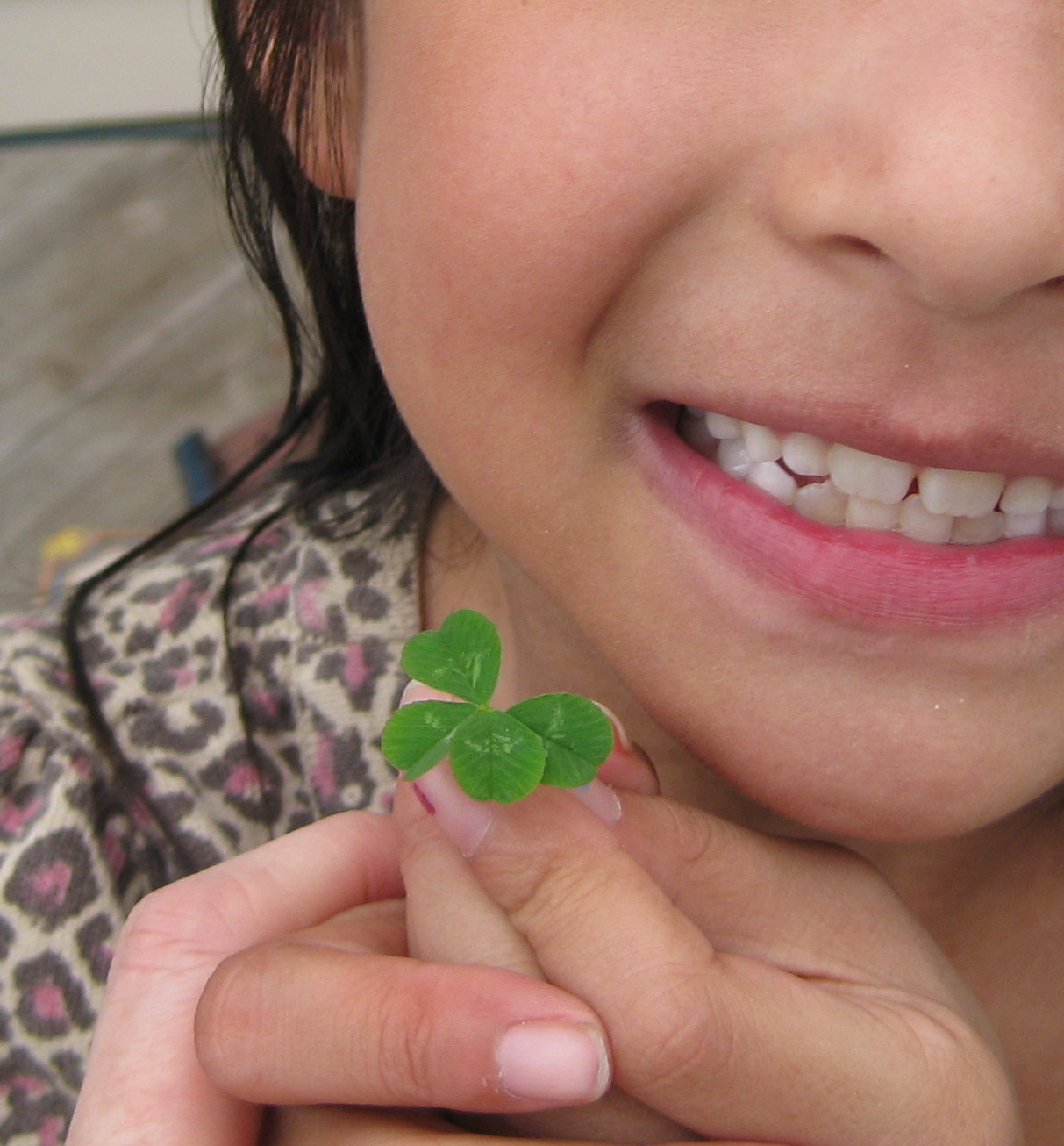
    The radioactive green grass has since died off, giving way to other things greener and hardier, including clover, but I’m thinking it may have altered the genetic makeup of my horticultural haven. Recently, my daughter came running into the house squealing, “Mommy! Mommy! I found a four-leaf clover!” Well, of course I thought she had smooshed two clover stems together to make them look like one four-leaf clover. But she hadn’t. In her hands, she held a perfect four-leafed clover. She gave it to me and ran outside to find more. “That’ll keep her happy for a while,” I thought, but she was back in the house in a matter of minutes. Turns out, one particular spot in my yard is full of four-leaf clover. My daughter and her friend even found a five-leaf clover.

    I’m not a superstitious person on the whole, but I’m thinking the TruGreen® guy is going to have to find another yard to spray. In fact, the only way he’s welcome back is on his knees, looking for a six-leaf clover.

    Copyright 2011 by Janice Lindegard. All rights reserved.

  • Inside My Head

    There is a foul-mouthed, judgmental witch in my life. I’m ashamed to admit that I even know her, but there is nothing I can do to eradicate her presence. You see, she lives inside my head.

    I am, by nature, a curious person. At the same time, I like to do things “the right way,” which means that I do lots and lots of research on what is the right way to do particular things, especially household tasks. The voice inside my head, therefore, has an opinion about everything, from how people should brush their teeth (two minutes, reaching all tooth surfaces) to how they should fold their sheets (the way I do).

    Naturally, I am a huge fan of Martha Stewart. Martha understands me. She knows that there must be a best way to do everything and she will find it, by God. Take the dishwashing liquid bottle on the counter, for example.  Probably eighty percent of the households in America have a big plastic bottle of green or blue liquid dishwashing soap sitting to one or the other side of the kitchen sink. I had one. I thought it was ugly. Martha had one. She thought it was ugly. In a stroke of genius worthy of a NASA engineer, Martha decanted the brightly colored liquid into a beautiful glass bottle and topped it all off with an attractive liquor pouring spout. I immediately bought a beautiful glass bottle, filled it with Dawn and set it beside my sink. It made me smile. But that wasn’t good enough for the voice inside my head. No, every time I spy a plastic dishwashing bottle while visiting someone’s home the voice inside my head says, “Ewwww!”

    “Ewww” is one of the tamer things that rattles around my brain. “Hooker” pops up more often than I like to admit. I have no idea why, but the “inside my head” voice sees hookers just about everywhere I go. I was in Target this past winter. I was doing the economy a favor, pushing my cart up and down the aisles. I turned a corner to find a young woman wearing a heavily ruffled blouse under a pea coat, which was heavily ruffled in the back. My eyes traveled south of the ruffled pea-coat-butt to the thigh-high, black suede high-heeled boots and “Hooker!” popped into my head. I saw similar boots on a five-year-old girl at the mall not long after that. Right after “Hooker boots!” popped into my head, I wondered, “Who buys hooker boots for a five-year-old?”, immediately followed by “Who makes hooker boots for a five-year-old?”

    While playing Fashion Police is a favorite activity inside my head, I really get cranking when someone ticks me off. This seems to be happening more and more during my regular runs. I mostly do trail running, usually through a prairie preserve near my home. Recently, my daughter begged to join me. Inside my head I was whining about not getting my mileage for the week but my mommy instinct won and my daughter and I headed to the prairie despite 20 mph winds and a constant drizzle.  We ran one and one-half miles with the wind yanking my daughter’s hat off her head every chance it got. Back at the trailhead, I spied a couple dressed, to my mind, completely inappropriately. Being the considerate person I am, I attempted to warn them that the wind was fierce that day. “I’m sure it is,” said the woman runner, giving me her best “maybe you can’t hack it, but I can” smile. I do not like condescension and, inside my head at least, I’m not particularly mature either. “I hope your hat blows away,” I thought.

    While condescending runners get my goat, it’s the cyclists on the trail that really set my inner witch to wagging her tongue. When I was a cyclist, I was ever so considerate. I never cut anyone off; I never rode on the wrong side of the path. Readying to pass another cyclist or a runner, I announced myself. “On your left,” I said, and then thanked the passee.  Not so those who share the trail with me. Many are the cyclists who whiz past me unannounced, scaring the whiz out of me. To each and every one, I think, “Get a bell, asshole!” as they speed out of sight.

    Inside my head, the trail I run is “my trail” and I am not particularly kind to those on my trail that I consider, shall we say, stupid. Witness the happy runner who trotted toward me on the wrong side of my trail. In America, we drive to the right, we walk to the right, we run to the right. I looked right at the wrong-sided runner. She did not yield. Instead, she smiled. “WTF,” I thought, so I gave her the universal WTF sign: palms raised to the sky, eyebrows up, quizzical look on my face. She did not yield. No, she smiled wider, waving, and trotted happily down the trail. “Idiot!” I thought, as I stepped out of her way.

    Immediately after thinking the idiot an idiot, I felt bad. “Maybe she’s from England,” I thought. “Maybe she has some leg length discrepancy that requires she run on the left side of the trail. Maybe I’m just mean and intolerant.” By the time I reached the end of my run, I had convinced myself that I am a nasty-minded, judgmental witch. See, as nasty-minded as I am toward others, I am hardest on myself. My children have called me fat, mean, stupid and ugly, though never all at once. It doesn’t get to me. I realize I am not fat, mean, stupid or ugly. But inside my head there is a constant barrage of insults. Can’t find my keys? “You are so stupid,” I tell myself. Gained a pound after having my annual turtle sundae? “Ack. You’re fat!” Reading a book instead of de-cluttering my office pig mess? “You’re so lazy!” You name it, my inner witch has a nasty comment for it.

    This morning, my daughter wanted me to hear a Selena Gomez song. In it, Selena sings, “Who say’s you’re not perfect?” My daughter sang merrily along while I held her in my lap and cried. Inside my head I thought, “I hope you never have a nasty, judgmental witch inside your beautiful, perfect head.”

    © 2011 by Janice Lindegard. All rights reserved. Photo: Martha Stewart.com